Amazon PPC
What is a good ACOS on Amazon?
There is no universal good ACOS. There is only your break-even ACOS, and almost nobody has calculated theirs.
12 min read
Service
Campaign structure, search-term governance and bid discipline, with the ACOS target derived from your break-even after fees, returns and COGS.
In practice
Our Amazon PPC experts run Sponsored Products, Sponsored Brands and Sponsored Display against one number: the contribution margin your account actually keeps.
Most Amazon advertising accounts are not underperforming because of bad bids. They are underperforming because the structure underneath the bids makes good decisions impossible.
When branded and non-branded terms share a campaign, the branded conversions subsidise the wasteful ones and the reported ACOS looks fine. When one budget covers thirty keywords, the two that convert get starved by the twenty-eight that do not. No amount of bid tuning fixes either problem. The account needs to be able to tell you where the money is going before it can tell you where it should go.
The first number I calculate is not ACOS. It is contribution margin per unit after referral fees, FBA fees, returns, storage and COGS. That gives a break-even ACOS. Everything above it is a deliberate decision to buy share; everything below it is profit extraction. Without that number, an ACOS target is guesswork with a decimal point.
Campaigns are split so that each one answers a single question. Exact-match harvest campaigns hold proven converters with bids that can be pushed. Phrase and broad campaigns exist to discover, with tight budgets and aggressive negation. Auto campaigns are research instruments, not revenue channels. Branded defence is separated entirely so it never flatters the numbers of everything else.
Search-term reports get worked every week, not every quarter. Converting terms graduate into exact match. Terms with clicks and no conversions get negated at the right level, campaign or ad group, depending on whether the term is bad everywhere or just bad in that context. This is unglamorous and it is where most of the recoverable waste lives.
Top-of-search converts differently from rest-of-search and product pages, and the same keyword deserves different bids in each. Placement multipliers get set from the account’s own data. Where volume justifies it, dayparting shifts budget toward the hours that actually convert instead of spending the day’s budget by 11am.
The person who reads your search-term report is the person who answers your email about it.
Campaign architecture, search-term work and bid discipline sit with Talha, who does this daily rather than supervising someone who does. Break-even and contribution margin — the numbers the bids are held against — sit with Faris. Account strategy and the decision about what advertising is allowed to do against stock and margin sits with me.
Three named people, all on one page with their actual focus listed. That is worth asking any agency you are considering, because the common answer is a senior operator in the pitch and a junior in the account.
Week one is read-only. Advertising console, business reports, inventory and settlement data. No changes. The output is a break-even figure per product and a list of what is currently structurally broken, which is often more than expected and occasionally less.
Week two is structure. Campaigns get segmented so each one answers a single question, branded defence gets separated out, Amazon PPC portfolios get regrouped around real budget decisions, and budgets get pointed at the things that convert. This is the change that moves the account most, and it usually makes the reported ACOS worse for a fortnight because branded conversions stop subsidising everything else. That is the number becoming honest, not the account getting worse.
Weeks three and four are search terms and placements, worked against real data rather than assumptions carried over from the previous setup.
Meaningful trend usually reads by week six to eight. Anyone promising a transformed account in fourteen days is describing a bid change, not a rebuild.
It will happen — a competitor funds a category, a hero ASIN stocks out, Amazon changes a placement behaviour.
What you get is the reason, in writing, before you ask for it. Then what is being done, and what it will cost to fix. What you do not get is a good month explained in detail and a bad one explained as market conditions.
The reason that is possible is that the account is held against its own break-even, not a benchmark. When you know what a product needed to earn, a bad month has an arithmetic explanation rather than a narrative one.
Published in full, with the console exports behind them:
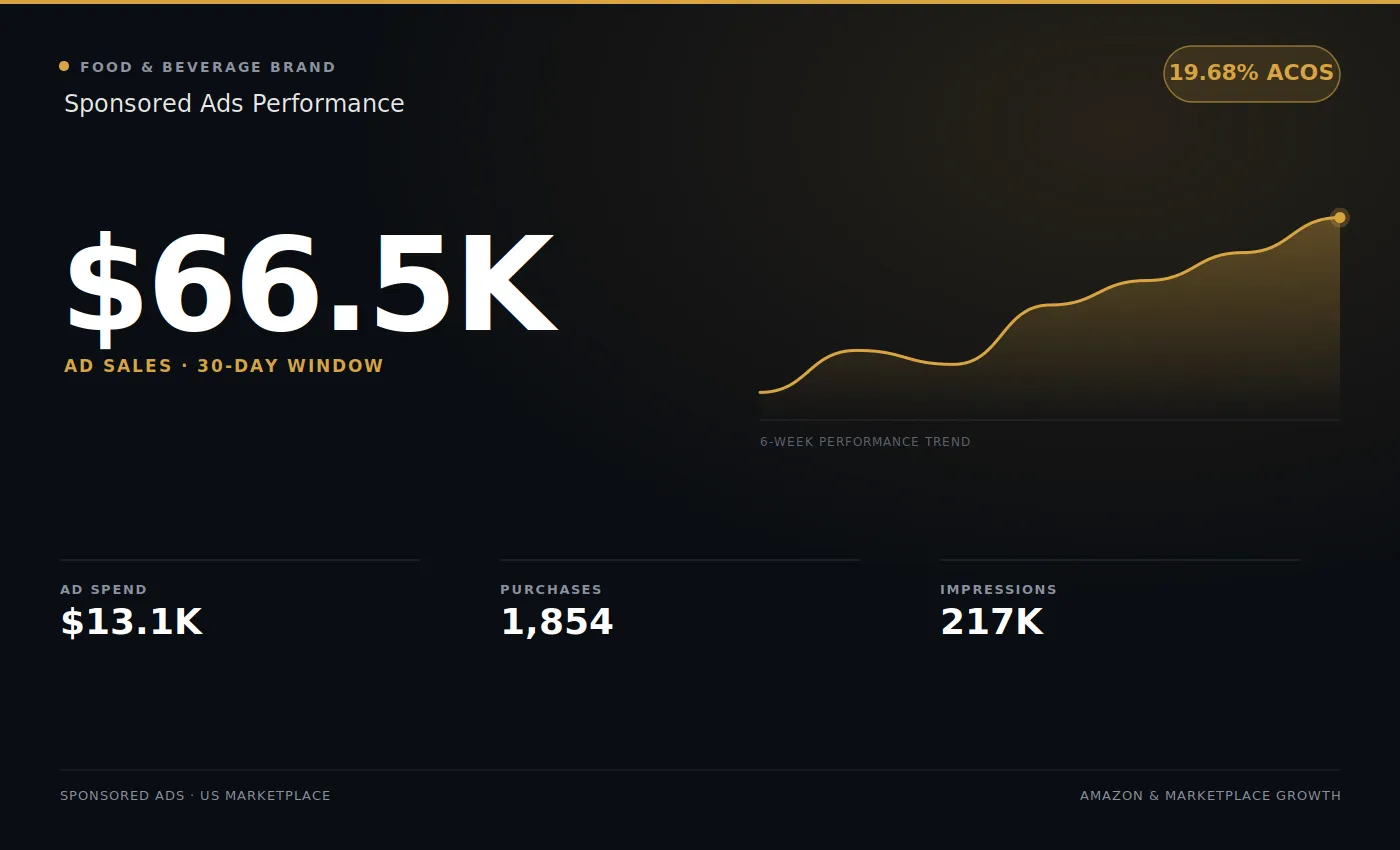
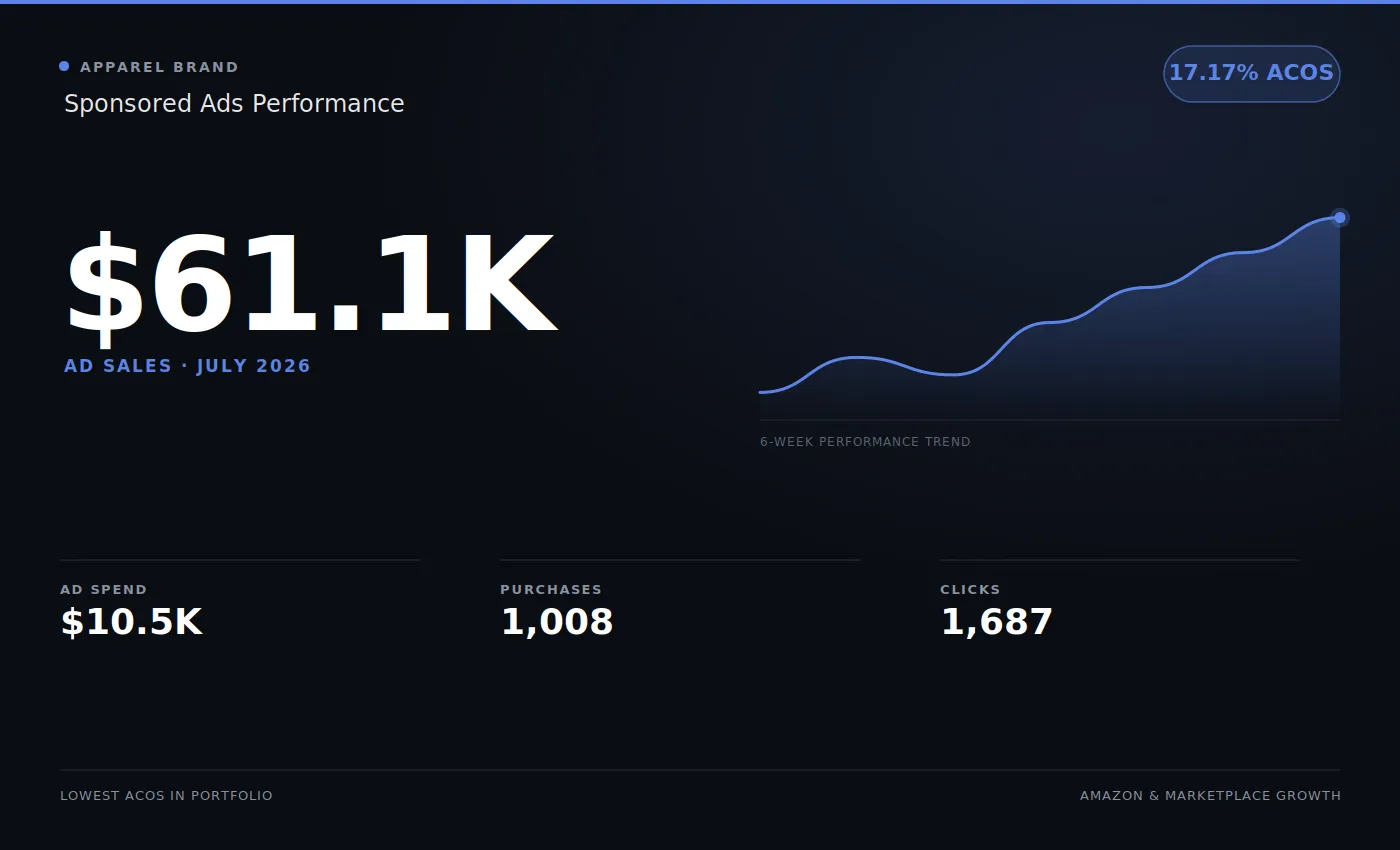
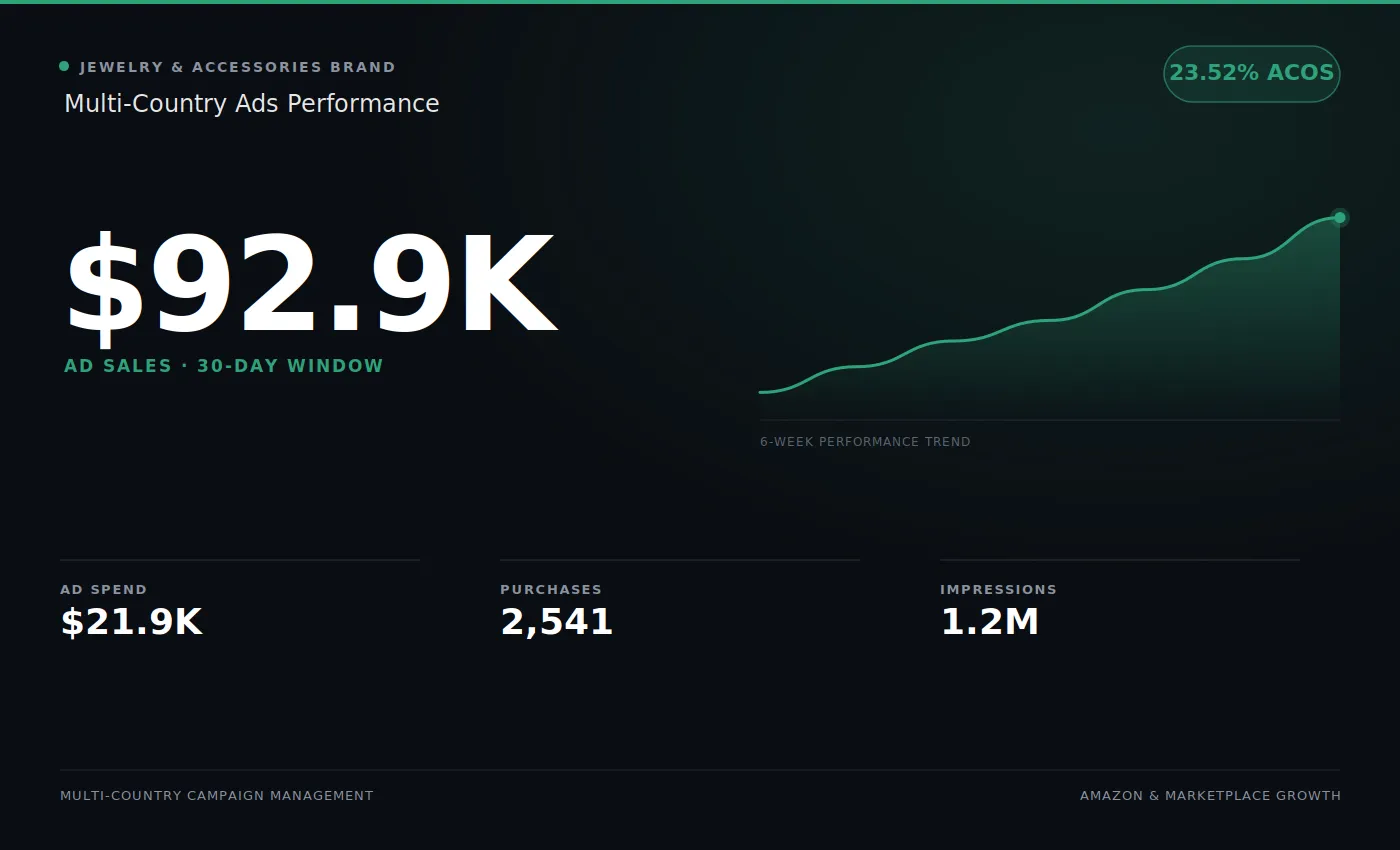
The jewellery account runs a higher ACOS than the apparel one and is the more profitable of the two per advertising dollar, because the margin structures differ. That is the whole argument for deriving a target rather than importing one. Consumables move it again, because repeat purchase makes a first order worth more than its own margin — Amazon PPC for food and beverage brands works through why.
By industry: Amazon agency for food and beverage brands, Amazon PPC for jewelry brands and Amazon PPC for apparel brands.
Weekly reporting that answers three questions: what changed, why it changed, and what is being done about it. Not a screenshot of a dashboard you already have access to.
Advertising is reported as its own layer, never folded into a total sales figure where a weak month can hide inside a good one.
The fee for this depends on catalog size, marketplaces and channel. How Amazon agency pricing is quoted walks through each factor.
I do not run advertising in isolation from the listing. A campaign pushing traffic to a detail page with a weak main image, missing backend keywords or a broken variation family is buying clicks that were never going to convert. If the listing is the constraint, I will tell you that before I take budget for ads, and listing optimization runs first — raising conversion rate lowers acquisition cost on every campaign pointed at that ASIN at once, including the ones already working.
The same logic applies to the account underneath it. Advertising on Seller Central is held against a contribution margin you control; advertising on Vendor Central is held against a wholesale margin you negotiate, and the bid ceilings that follow are genuinely different numbers.
How we approach the parts of this service that decide whether it pays.
Amazon PPC
There is no universal good ACOS. There is only your break-even ACOS, and almost nobody has calculated theirs.
12 min read
Amazon PPC
ACOS judges campaigns. TACOS judges the business. Optimising the first while ignoring the second is how accounts grow advertising sales and lose money.
6 min read
Amazon PPC
Most underperforming ad accounts are not badly bid. They are structured so that good bidding decisions are impossible to make.
7 min read
Amazon PPC
The search term report tells you what shoppers actually typed. Harvesting is the discipline of acting on it every week, in both directions, and most accounts only ever act in one.
7 min read
Amazon PPC
Top of Search converts better and costs more. The multiplier decides how much more, and it compounds with your bid rather than replacing it.
6 min read
Amazon PPC
Portfolios group campaigns for budget control and reporting. The budget cap is the part that matters, and it is the part that quietly does damage when nobody owns it.
6 min read
Common questions
Sponsored AdsSponsored Ads · Jewelry
Taking on new accounts
Send the marketplace, the category and what is currently going wrong. You get a written read on advertising structure, catalog health and the first three things worth changing, before any engagement is discussed. One of us reads it, not a form queue.