Amazon listing variations put related products (a parent ASIN and its child ASINs) on one detail page, and how that family is built decides more than most sellers expect.
Most listing audits return the same recommendations. Rewrite the title with more keywords. Improve the bullets. Add A+ content. Better main image.
All reasonable. None of it is usually the biggest available gain, which is structural and sits underneath the copy: how the variation family is built.
What the family actually does
A variation family groups related child ASINs (sizes, colours, quantities) under one parent so customers see a single listing with selectable options.
The structure determines three things that matter more than any sentence on the page:
Where reviews accumulate. Reviews consolidate across a properly built family. Every child benefits from the collective count. Split the family and each child starts from zero and fights alone.
Where rank accumulates. Sales velocity across the family contributes to the parent’s position. Fragmented families divide velocity into portions too small to rank on any of them.
What the customer sees first. The default child determines the price, image and review count shown on arrival. Wrong default, wrong first impression, on every single visit.
How parent-child variations are built
Every Amazon variation family has the same three parts:
- The parent ASIN. Not buyable. It holds the family together and carries the shared title and category.
- The child ASINs. The buyable products, each carrying the attribute values that differ: a size, a colour, a pack count.
- The variation theme. The rule for which attributes may vary, such as Size, Color or SizeColor. Available themes depend on the category, so the theme has to be chosen before the family is built, not after.
Families are created or edited in Seller Central through the Variation Wizard, or in bulk with a flat file that sets each row’s parent, relationship and theme. Existing ASINs can be moved under a parent the same way, which is how an over-split catalog gets repaired without relisting anything.
The two failure modes
Over-split
Each size and colour listed separately. Common in catalogs built incrementally, where products were added one at a time and never restructured.
The result: forty listings with eleven reviews each instead of one listing with 440. Advertising has to fund forty separate campaign targets. No individual child reaches the review count where conversion improves materially.
This is by far the more common and more damaging error. It is also the one most listing audits do not mention, because fixing it is catalog surgery rather than a copy deliverable.
Over-merged
Genuinely different products forced into one family to borrow review equity. Amazon’s variation policy prohibits this, and enforcement (suppression, or forced splits that scatter reviews unpredictably) arrives eventually.
It also confuses customers. A family containing three unrelated products means two-thirds of visitors land on something they were not looking for.
Both fixes are catalog work (merging, splitting and re-theming families without losing reviews), which is why restructuring variation families is a core part of our Amazon listing optimization rather than an optional extra.
Getting the default child right
The default child appears for everyone arriving without a specific selection. Its price is the price they see. Its image is the image they judge. Its availability is what tells them whether you are in stock.
Two defaults cause quiet, continuous damage:
Defaulting to the cheapest child anchors price perception low and pushes customers toward the variant with the worst margin.
Defaulting to an out-of-stock child is worse. The listing reads as unavailable even though most of the family is in stock, and a share of visitors leave without discovering otherwise.
Neither shows up in a copy review. Both are visible in a five-minute catalog check.
Why apparel is the hardest case
Apparel families are large, twenty or more children once size and fit are accounted for, and returns are driven by sizing, which is a family-level content problem rather than a per-child one.
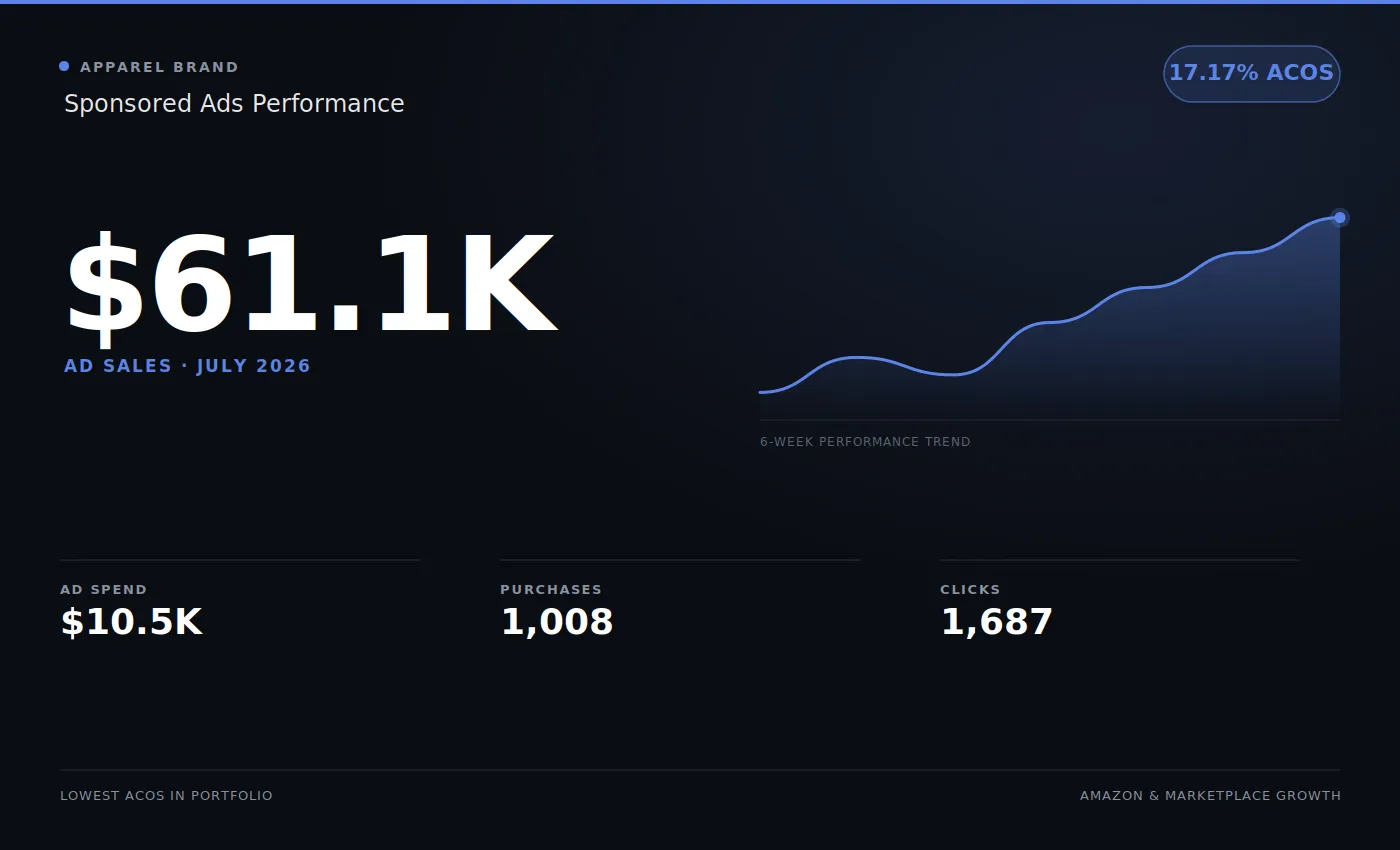
Sizing guidance has to live where customers see it before selecting, not buried in a child description they will never open. Get this wrong and the returns come back through the same margin your ACOS is measured against, which is why the apparel account in my portfolio treated family structure and sizing content as advertising work.
Backend search terms, and the myths around them
Backend search terms exist for synonyms, misspellings and long-tail variants with no natural home in visible copy.
Three rules that are consistently broken:
Do not repeat terms already in the title. Repetition adds nothing. The field is finite and every wasted character is a term you could have covered.
Do not use commas. Amazon’s field does not need them and they consume the byte limit.
Verify indexation afterward. Assuming a term is indexed because it was entered is how accounts end up invisible for terms they are confident they rank for. Search the exact term plus your ASIN and confirm the listing returns.
International listings are not translations
A translated amazon.com listing is a draft for amazon.de, not a finished listing.
German search behaviour uses compound terms that do not map one-to-one from English phrases. UK sizing conventions differ from US. Category browse structures differ by marketplace. The objection that stops a French buyer is not necessarily the one that stops an American one.
Localised keyword research per marketplace is part of the work. Running the US listing through translation produces a page that is grammatically correct and searches for nothing.
Amazon variation optimization: a catalog audit that finds real problems
- Map every variation family. Find the over-splits first. That is where the largest recoverable value sits.
- Check every default child for price anchoring and availability.
- Verify indexation on your top twenty terms instead of assuming it.
- Check suppressions and stranded inventory. Products silently unavailable earn nothing and are easy to miss.
- Audit image compliance: main image requirements are technical and enforced.
- Review backend fields for repetition and wasted characters.
- Compare marketplace by marketplace instead of assuming the US listing translated well.
Steps one and two regularly return more than a full copy rewrite, and they are cheaper.
Family structure, backend hygiene and child-level content are standing items in our Amazon listing optimization, not one-off audit outputs.