First-party selling takes away most of the levers a seller is used to. You do not set the retail price, you do not win a Buy Box, and you cannot relist your way out of a weak ASIN. What is left is content, fill rate and cost negotiation.
Annual Vendor Negotiations are where the last of those happens, once a year, and they set how much of every future purchase order you actually keep. A vendor can run a clean operation all year and still lose the margin in one email thread they were not prepared for.
What the last round looked like
Consulterce surveyed vendors on the 2025 negotiations, and the numbers explain why preparation matters (Consulterce, 2025 AVN study):
- 93% of vendors ended the round with higher total trade terms than the year before.
- Terms rose by 91 basis points on average, up from 69 the year before, to about 18.6% of net sales.
- 49% said their net margin declined.
- 50% reported facing punitive measures during the negotiation.
- The average negotiation ran 3.2 months from start to finish.
Amazon asks for more nearly every year, and nearly every vendor ends up giving some of it. The question is how much, and what you get back.
What Amazon is negotiating
AVN is not a negotiation about your cost price in the way most people expect. It is mostly about the terms that come off it afterwards.
When Amazon pays a vendor, it pays for shipped units at the agreed cost. Then the negotiated terms are deducted, usually as a percentage of that shipped cost. These deductions are contra-COGS, and they typically include:
- Marketing or co-op allowances: funding Amazon takes to support the catalog.
- Damage allowances: a fixed rate in place of claiming for each damaged unit.
- Freight allowances: where Amazon collects the goods rather than you delivering them.
- Payment terms: how long Amazon takes to pay, which is a cost of cash, not of goods.
- Other accruals specific to your category or agreement.
Each one looks small on its own. Stacked, they decide your real margin, and because they scale with shipped cost, they grow with the account whether or not the money is doing anything. The chargebacks guide covers how contra-COGS sits next to operational deductions on the same remittance.
Why a fraction of a point matters
Take a hypothetical product that Amazon buys from you at $20, and that costs you $14 to make and deliver:
| Per unit | |
|---|---|
| Cost price paid by Amazon | $20.00 |
| Your cost of goods | $14.00 |
| Gross margin | $6.00 (30%) |
| Trade terms at 18.6% of cost price | −$3.72 |
| What you actually keep | $2.28 |
| Terms after a 91 basis point increase (19.51%) | −$3.90 |
| What you keep after the increase | $2.10 |
An increase of less than one point on the terms line takes about 8% of your real margin on that product. Across $2M of shipped cost, the same increase is roughly $18,200 a year, before any chargebacks. That’s why the headline number in the proposal matters less than what it does to each ASIN’s margin.
How Amazon reads your account
Amazon comes into AVN with a view of how profitable your catalog is to Amazon. That view is built from its own margin on your products after cost, terms and discounts (Vendor Central reports it as Net PPM), and it decides the tone of the proposal.
Three things shape it:
- Profitability by ASIN. Products Amazon makes money on get more room. Products it loses money on become a reason to ask for more support, or to stop ordering them.
- Operational reliability. Fill rate, on-time delivery and chargeback history. A vendor who ships what was confirmed, on time, to specification is cheaper for Amazon to run.
- Growth. A growing catalog earns more patience than a flat one.
You can’t change the first one in the negotiation itself. You can arrive knowing it, and you can make sure the second one is working in your favour.
What to prepare before the first email
This is the part most vendors skip, and it decides the outcome more than anything said in the negotiation.
- Net margin per ASIN after this year’s terms. Shipped cost, minus contra-COGS, minus chargebacks, minus your cost of goods. This is your real margin. If you only know the headline cost price, you are negotiating blind.
- What each allowance cost you, and what it bought. Total each term over the year. For marketing and co-op funding, write down what it visibly paid for. A term you cannot tie to an outcome is the first one to push back on.
- Your operational record. Fill rate, ordered versus shipped, on-time delivery, and chargebacks by reason code over the year. If the record is clean, it is evidence. If it isn’t, fix the top reason codes now, before the terms are set, not after.
- The ASINs at risk. Which products fall below your margin floor under a small increase in terms. Those are the ones Amazon may also be questioning, and you need a position on each before it comes up.
- Any cost changes you need. If raw materials, freight or duties have moved, the evidence belongs in the same preparation, not in a separate request that arrives mid-negotiation. Our guide to getting a cost price increase approved covers what that evidence should look like.
- A give-and-get list. What you could offer (funding for a launch, a longer commitment on a line, better delivery performance) and what you want for it. Never offer from the first column without an item from the second.
- Your walk-away position. What happens if the terms become unprofitable. For some catalogs the answer is moving part of the range to Seller Central: 47% of vendors in the same survey said a hybrid 1P and 3P model is becoming more relevant. Knowing your answer changes how firmly you can say no.
During the negotiation
- Trade, don’t concede. Every increase you accept should buy something specific: a commitment, a promotion, a lower term elsewhere.
- Count the total, not the headline. A lower rate on one allowance can be undone by a new accrual or longer payment terms. Model the full stack against your per-ASIN margin before agreeing.
- Ask what the funding does. For marketing or co-op money, ask how it will be used and how you will see the result. Funding with no visible output is the easiest term to argue down.
- Get it in writing. Confirm the agreed terms, the rates and the start date in writing before anything takes effect.
After it closes
The negotiation is not over when the terms are agreed. It is over when the first remittances under the new terms match what was agreed.
Model the new terms into next year’s per-ASIN margins straight away, and flag any product that now sits below your floor. Then check the first few remittances line by line. A term applied at the wrong rate, or from the wrong date, is far easier to correct in the first month than in the fourth.
Why operations are your strongest leverage
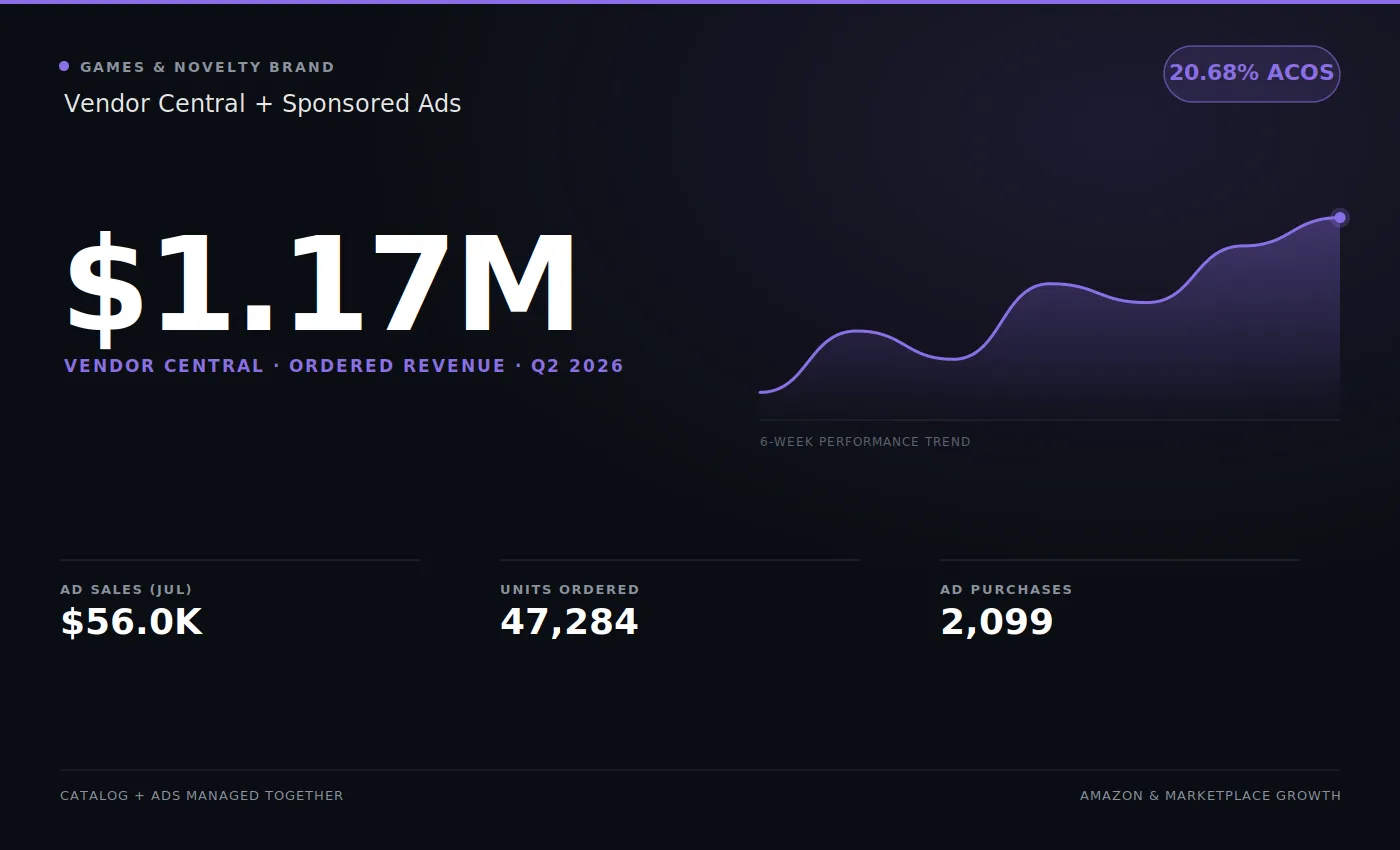
Most of what makes a vendor strong in AVN is decided long before it starts. On the Vendor Central quarter in our portfolio, ordered and shipped revenue both landed at roughly $1.18M, within about a tenth of a percent of each other: what was confirmed was delivered. That record, combined with clean chargeback history, is what gives a vendor the standing to say no to a term.
That year-round discipline, plus the preparation above, is most of what our Amazon Vendor Central experts do for 1P accounts. The negotiation itself is the smaller part of the work.