Marketplace & PPC operations
Amazon growth.
Managed by Amazon’s Experts.
A stronger business. Not just a better dashboard.
PPC, account management and marketplace operations, working together. We turn the details into a clear path to profitable growth.
Three operatorsFive years inNine marketplaces
STRATEGY / ADVERTISING / OPERATIONSExplore the impact
Ad spend$57,100
Ad sales$276,600
Return on ad spend4.84×
Per $1 of ad spend$4.84 returned
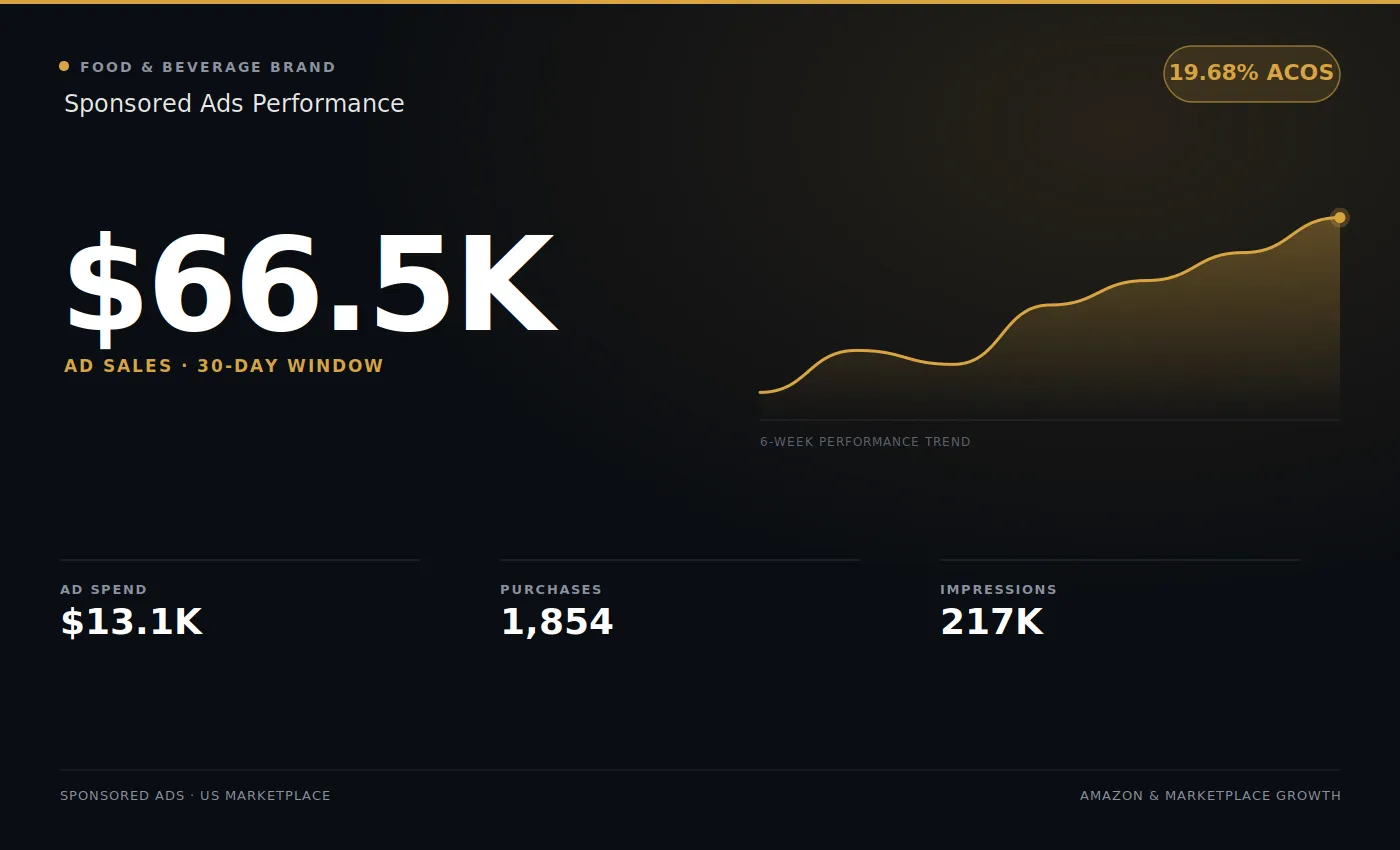
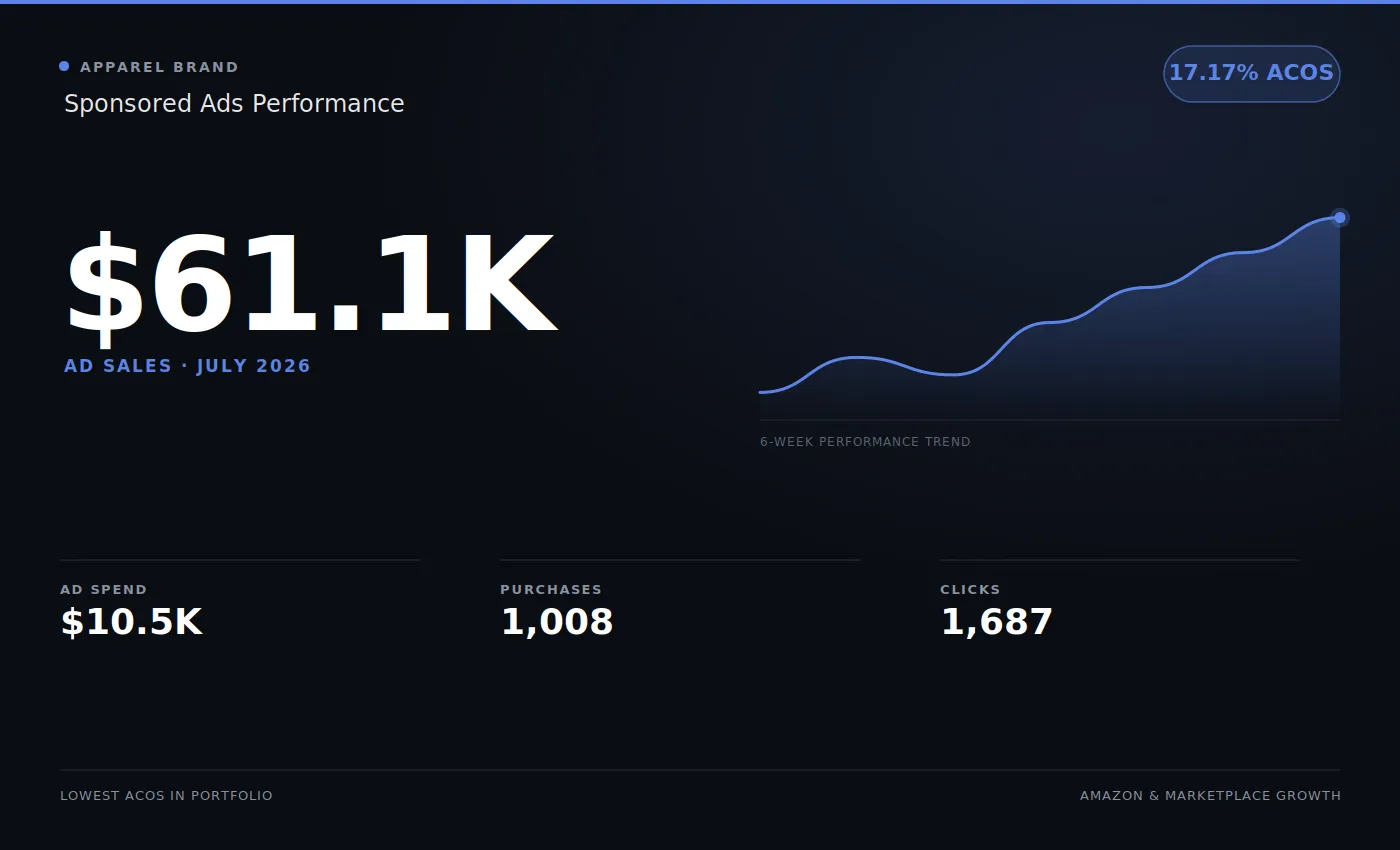
Advertising return across 4 accounts. Apparel brand: $10,500.00 of ad spend returned $61,100.00 in ad sales, a 5.82 times return. Food & Beverage brand: $13,100.00 of ad spend returned $66,600.00 in ad sales, a 5.08 times return. Games & Novelty brand: $11,600.00 of ad spend returned $56,000.00 in ad sales, a 4.83 times return. Jewelry & Accessories brand: $21,900.00 of ad spend returned $92,900.00 in ad sales, a 4.24 times return. In total, $57,100.00 of ad spend returned $276,600.00 in ad sales.
- USamazon.com
- CAamazon.ca
- MXamazon.com.mx
- UKamazon.co.uk
- DEamazon.de
- FRamazon.fr
- ITamazon.it
- NLamazon.nl
- SEamazon.se
Track recordFive years, nine markets
The numbers behind the pitch.
Every figure on this site is a reported export from an account we managed. Nothing is modelled, projected or rounded up.
- Years on Amazon
5+
Years on Amazon
Seller Central and Vendor Central
- Accounts managed
26+
Accounts managed
Brands and aggregators
- Marketplaces
9
Marketplaces
North America and Europe
- Quarterly vendor revenue
$1.18M
Quarterly vendor revenue
Ordered revenue, single account
Selected work4 published
Accounts, and what they actually returned.
Sponsored AdsSponsored Ads · Jewelry
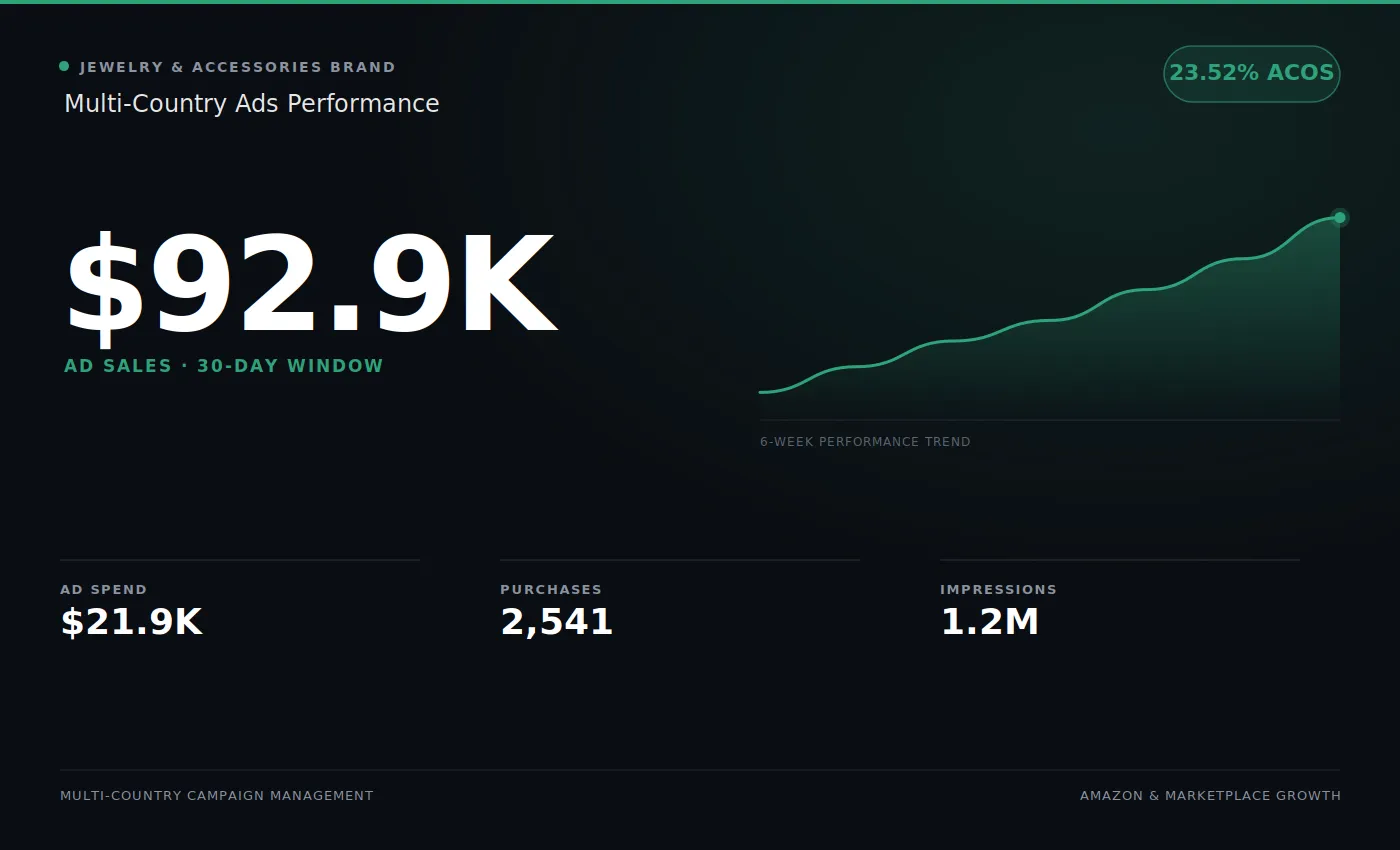
Jewelry & Accessories brand
- Ad sales
- $92.9K
- ACOS
- 23.52%
- Impressions
- ~1.24M
Vendor CentralVendor Central · Games & Novelty
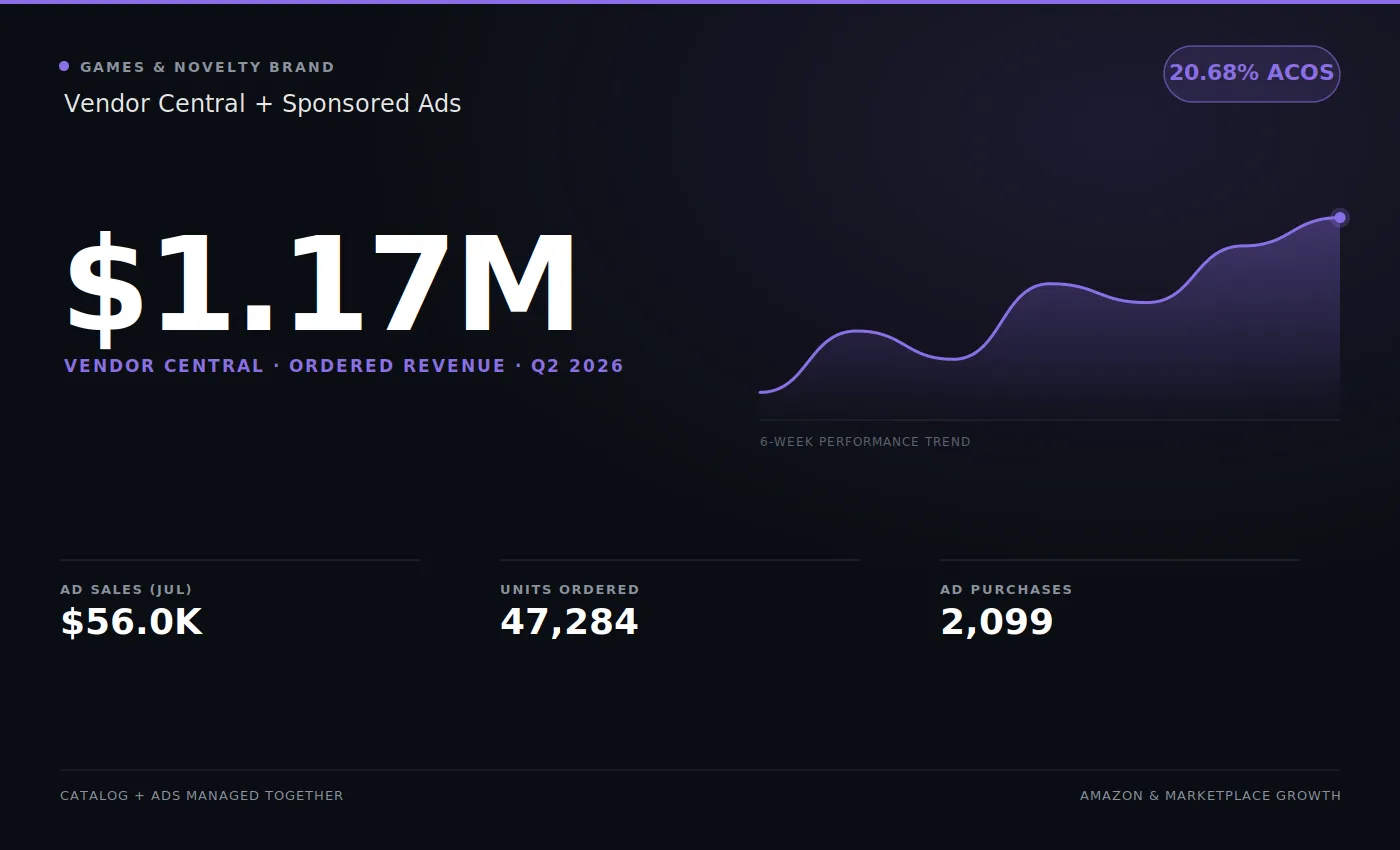
Games & Novelty brand
- Ordered revenue
- $1.18M
- Ordered units
- ~47,300
- Ad ACOS
- 20.68%
Account trajectory
Three months of a Seller Central account under management.
Monthly ordered sales for one Seller Central account over a period in which we handled advertising and catalog operations. Shown as reported account performance, not as an isolated attribution of growth.
That curve is Seller Central managementrun as one job — catalog, advertising, inventory and pricing moving together. The single largest contributor early on is usuallylisting optimization, because conversion rate sets acquisition cost on every campaign at once. Where advertising is the binding constraint instead, the work sits with ourAmazon PPC experts.
Monthly ordered salesMar–May
- Mar$169K
- Apr$264K+56%
- May$531K+101%
Capabilities7 services
What we take on, and what the problem usually turns out to be.
Amazon Account Management
Full-lifecycle Amazon operations across nine marketplaces, coordinating catalog, advertising, inventory and pricing in one view.
- Cross-channel account architecture
- Unified catalog, advertising & inventory planning
- Multi-marketplace operational rhythm
- Account health & policy governance
Service detail
Amazon PPC Management
Campaign structure, search-term governance and bid discipline, with the ACOS target derived from your break-even after fees, returns and COGS.
- Campaign architecture rebuild
- Search-term harvesting & negation
- Placement & bid governance
- Budget pacing by margin
Service detail
Amazon Seller Central Management
Seller Central operations: catalog quality, advertising efficiency, FBA inventory planning, pricing and Buy Box position.
- Catalog & variation structure on Seller Central
- Advertising efficiency & campaign structure
- FBA inventory planning & storage cost
- Pricing & Buy Box optimization
Service detail
Amazon Vendor Central Management
Purchase orders, fill rate, chargebacks, A+ content and Vine, plus reporting that separates ordered revenue from what actually shipped.
- Purchase order management
- Ordered vs shipped reconciliation
- Retail analytics reporting
- A+ content & brand store
Service detail
Amazon Listing Optimization
Indexation checked first, then titles, bullets, backend terms, imagery and A+ content written against the objection that stops the sale.
- Keyword research & indexation audit
- Title, bullet & description rewrite
- Backend search term optimisation
- Image & infographic direction
Service detail
Amazon FBA Management
Restock planning, shipment execution, stock cover modelling and storage fee control, with bids scaled to the cover each ASIN actually has.
- Restock & replenishment planning
- FBA shipment creation & tracking
- Stock cover & runway modelling
- Storage fee & aged inventory control
Service detail
Amazon Account Audit
A scoped diagnostic that finds the waste and risk in an Amazon account and ranks what to fix first — one report, no ongoing commitment.
- Full catalog quality review
- Advertising spend & structure audit
- Inventory exposure & storage cost assessment
- Account health & policy risk check
Service detail
Coverage9 marketplaces
Nine marketplaces, run as nine different problems.
North America3 markets
- United Statesamazon.com
- Canadaamazon.ca
- Mexicoamazon.com.mx
Europe6 markets
- United Kingdomamazon.co.uk
- Germanyamazon.de
- Franceamazon.fr
- Italyamazon.it
- Netherlandsamazon.nl
- Swedenamazon.se
Marketplaces managed: United States, Canada, Mexico, United Kingdom, Germany, France, Italy, Netherlands, Sweden.
1P vs 3PBoth, in production
Seller Central and Vendor Central are not the same job.
Teams who learned on one and inherit the other reach for levers that do not exist there. We run both, in production.
3PThird-party, you sell to the customer
Seller Central
- You
- Customer
You own the customer transaction and every lever that goes with it. The work is operational breadth: catalog, ads, inventory, pricing and account health move together, and we run them as one job rather than four.
What you control
- Retail price
- Buy Box position
- Inventory placement
- Listing creation
1PFirst-party, you sell to Amazon
Vendor Central
- You
- Amazon
- Customer
Amazon sets retail price and owns the transaction. The work is a wholesale relationship: fill rate, chargebacks, cost negotiation and content, with no option to relist your way out of a weak ASIN. We have run 1P at over a million dollars of ordered revenue in a quarter.
What you control
- Cost price & terms
- Purchase order acceptance
- Catalog content
- Advertising
Stack9 tools
Tools, grouped by the decision they inform.
Research & keyword intelligence
- Helium 10
- Keyword research, index checks, listing audits
- DataDive
- Keyword gap analysis and reverse-ASIN clustering
- Jungle Scout
- Category demand and competitor benchmarking
Advertising & bid management
- Pacvue
- Enterprise campaign management and dayparting
- Perpetua
- Goal-based automation and budget pacing
- PPC Ninja
- Search-term harvesting and negation workflows
- Xnurta
- Cross-marketplace advertising reporting
Profitability & analytics
- Sellerboard
- True net profit, fee and return reconciliation
- Datarova
- Account-level performance analytics
Team3 operators
Three operators, one view of the account.
Advertising, margin and marketplace operations sit with three named people, and the one who reads your search-term report is the one who answers your email about it.

Five years across Seller Central and Vendor Central, 26 accounts and nine marketplaces. Owns the account as one connected P&L: what advertising is allowed to do is decided against stock, margin and catalog health rather than in isolation.
On the account
- Account strategy and P&L ownership
- Vendor Central: purchase orders, fill rate, chargebacks
- Catalog, variations and account health
- Inventory planning against bid strategy

Holds the commercial side of the account: fee and settlement reconciliation, contribution margin per ASIN, and the pricing and cost work that sets what a bid is allowed to be. Also runs marketplace operations alongside it.
On the account
- Contribution margin and break-even ACOS
- Fee, settlement and reimbursement reconciliation
- Pricing, COGS and promotion economics
- Marketplace operations and reporting

Works the advertising layer day to day: campaign build, search-term governance and bid discipline against the margin targets the account is held to. Also builds the internal tooling that turns raw Amazon exports into decisions.
On the account
- Campaign architecture and match-type structure
- Search-term harvesting and negation
- Placement multipliers and budget pacing
- Reporting and workflow automation
Amazon insights
Insights18 articles
Amazon PPC
What is a good ACOS on Amazon?
There is no universal good ACOS. There is only your break-even ACOS, and almost nobody has calculated theirs.
12 min read
Amazon PPC
ACOS vs TACOS
ACOS judges campaigns. TACOS judges the business. Optimising the first while ignoring the second is how accounts grow advertising sales and lose money.
6 min read
Amazon PPC
Amazon PPC campaign structure
Most underperforming ad accounts are not badly bid. They are structured so that good bidding decisions are impossible to make.
7 min read
Vendor Central
Vendor Central vs Seller Central
In Vendor Central you sell to Amazon. In Seller Central you sell through it. Almost every practical difference follows from that one sentence.
12 min read
Amazon FBA
What an Amazon stockout actually costs
The lost margin on units you could not sell is the smallest part of a stockout. The rank you have to rebuy is the expensive part.
7 min read
Catalog Management
Amazon variation listings and parent-child families
How a variation family is built usually matters more than any individual word on the detail page, and it is the fix most listing audits never mention.
10 min read
Seller Central
Why Amazon accounts stop growing
A brand with a PPC freelancer, a copywriter, a shipping VA and an account-health VA has four competent people and one structural problem.
7 min read
Amazon PPC
Amazon PPC portfolios, explained
Portfolios group campaigns for budget control and reporting. The budget cap is the part that matters, and it is the part that quietly does damage when nobody owns it.
6 min read
Amazon PPC
Amazon PPC for food and beverage brands
Advertising a consumable is not advertising a durable good with different keywords. Expiry, reorder rate and shelf-life ceilings change what you can bid and how long you wait to judge it.
7 min read
Amazon PPC
Search term harvesting, as a weekly routine
The search term report tells you what shoppers actually typed. Harvesting is the discipline of acting on it every week, in both directions, and most accounts only ever act in one.
7 min read
Vendor Central
Vendor Central chargebacks, and how to stop them
A 1P account rarely loses margin in one visible place. It loses it in small compliance deductions that nobody owns, applied per shipment, discovered a quarter later.
7 min read
Amazon PPC
How to set Amazon placement multipliers
Top of Search converts better and costs more. The multiplier decides how much more, and it compounds with your bid rather than replacing it.
6 min read
Catalog Management
What Amazon A+ content actually does
A+ is a conversion and returns instrument. Treating it as an SEO surface wastes the modules, because most of what you write inside them is sitting in an image.
6 min read
Catalog Management
Finding the listings with no lifestyle image, across a full catalog
A lifestyle image on a jewellery listing is not decoration — it is scale and context a product-on-white shot cannot give a buyer. Finding which ASINs lack one, across nearly two thousand of them, is not a task a person does by clicking through each page.
8 min read
Vendor Central
Amazon annual vendor negotiations, and how to prepare for them
Most of a 1P vendor's margin for the coming year is decided in one negotiation. The vendors who come out of it well are the ones who walked in knowing their net margin per ASIN, what each allowance bought them, and where they would walk away.
8 min read
Vendor Central
How to get a cost price increase approved in Vendor Central
Filing the request takes ten minutes. Getting it approved depends on everything you prepare before you file: the evidence, the effect on Amazon's margin, and what you do if the answer is no.
7 min read
Vendor Central
Vendor Central purchase orders: confirmation, fill rate and cancellations
Fill rate is not decided in the warehouse. It is decided in the few minutes when someone confirms a purchase order, and the most common mistake is accepting quantities the business cannot ship.
9 min read
Vendor Central
Amazon Net PPM, and why Amazon stops ordering an ASIN
Every vendor tracks its own margin. Amazon tracks its margin on you, and that number shapes how much it orders, how hard it pushes in the annual negotiation, and whether it keeps a product at all.
9 min read
- All insightsRead the index
Taking on new accounts
Start with an account audit.
Send the marketplace, the category and what is currently going wrong. You get a written read on advertising structure, catalog health and the first three things worth changing, before any engagement is discussed. One of us reads it, not a form queue.
- Reply
- One working day
- First read
- Free, in writing