Seller Central
Why Amazon accounts stop growing
A brand with a PPC freelancer, a copywriter, a shipping VA and an account-health VA has four competent people and one structural problem.
7 min read
Service
Seller Central operations: catalog quality, advertising efficiency, FBA inventory planning, pricing and Buy Box position.
In practice
Seller Central is a platform with a specific set of levers, and accounts on it fail for specific, repeatable reasons. Advertising that scales into a product about to stock out is not a good campaign. A listing rewrite that changes the title while a Sponsored Brands headline still references the old positioning is not an improvement. These are coordination failures, and they are the most common cause of flat months on otherwise healthy Seller Central accounts.
This page is scoped to Seller Central operations — catalog, advertising, inventory, pricing and health within your existing Seller account. For brands selling across both Seller and Vendor Central, account management covers the cross-channel coordination.
Before anything is advertised, the catalog has to be correct: variation families structured the way customers actually shop, images meeting Amazon’s technical requirements, backend keywords doing work rather than repeating the title, and browse nodes putting products in categories where the demand exists.
Stock cover drives bid strategy. Deep cover means push. Thin cover means protect rank rather than chase volume, because winning a rank position you cannot hold is expensive twice, once to buy it and once to rebuild it after the stockout. FBA shipment planning, restock limits and long-term storage exposure are managed against that reality.
Buy Box percentage is monitored as a first-class metric, not checked when sales drop. Price changes are made with awareness of what they do to advertising efficiency and to any active deal or coupon, rather than in isolation.
Policy warnings, listing suppressions, IP complaints and Order Defect Rate movement are checked on a fixed cadence. Almost every expensive account health problem started as a cheap one that nobody was watching.
I operate accounts in the United States, United Kingdom, Canada, Mexico, Germany, Italy, France, Sweden and the Netherlands. Each marketplace has its own search behaviour, competitive density and compliance requirements. A catalog that is optimised for amazon.com is a starting draft for amazon.de, not a finished listing.
A weekly written summary covering sales and advertising movement, inventory position, account health status, and what is planned next. Monthly, a deeper read on category position and where the next increment of growth is most likely to come from.
Accounts rarely stall for a novel reason. They stall in one of four ways, and the pattern is consistent enough to check for directly.
Advertising scaled past supply. Budget increases into an ASIN with three weeks of cover buy a stockout, and the stockout costs the rank position the spend just paid for. The rebuild afterwards routinely costs more than the margin on the units that were never available. This is the most expensive of the four and the easiest to prevent.
Catalog drift. Titles change, variation families split, browse nodes get reassigned by Amazon without notice, and campaigns keep bidding into positioning that no longer exists on the page. Nothing breaks loudly; the account just converts slightly worse every month.
Buy Box erosion. Buy Box percentage is checked when sales drop rather than watched as a first-class metric, so a pricing or fulfilment issue is diagnosed weeks after it started costing money.
Account health left unattended. Every expensive suspension began as a cheap policy warning that nobody read. Order Defect Rate, IP complaints and listing suppressions are checked on a fixed cadence precisely because the cheap window is short.
Campaign work on a Seller account is bid discipline and search-term hygiene, but the part that matters is what those bids are held against.
ACOS on its own is a vanity constraint. A 25% ACOS is excellent on a 60% gross margin product and ruinous on a 22% one, and the difference is invisible unless the fee structure has actually been reconciled — referral fees, FBA fulfilment, storage, returns processing, and the deductions that only appear at settlement. Contribution margin per ASIN is established first, and the bid ceilings follow from it.
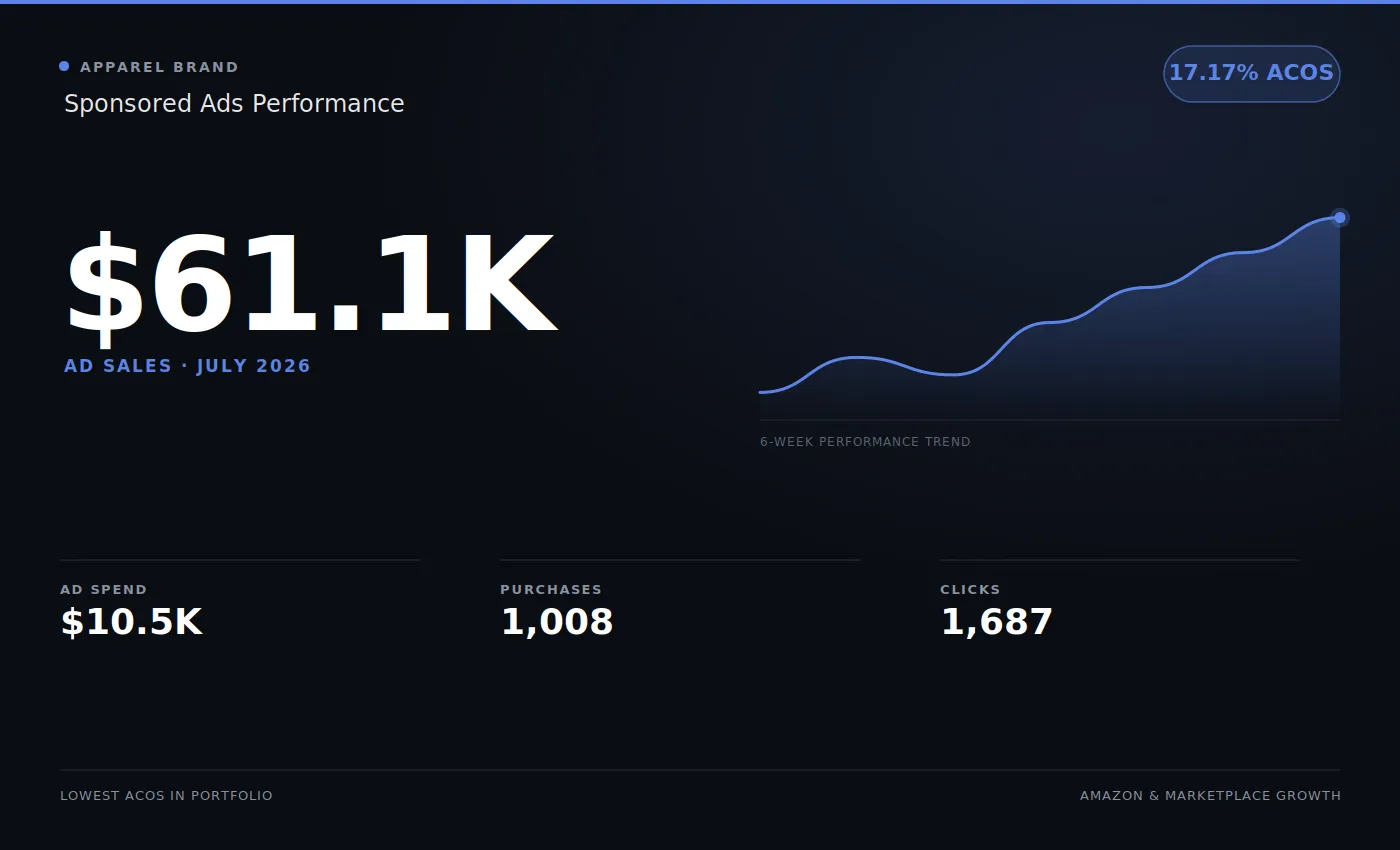
That reconciliation is why the advertising and the inventory sit with the same operation. Published examples of the advertising layer running this way are in the portfolio: a food and beverage brand where $13,100 of spend returned $66,600 in ad sales, a 5.08× return, and an apparel brand at $10,500 returning $61,100 at 17.17% ACOS.
This page is Seller Central specifically. Two adjacent boundaries are worth naming, because scoping them wrong is how engagements go sideways.
If you also sell first-party, that side needs Amazon Vendor Central experts. It is a different operation with different levers — you do not set retail price and you do not own the Buy Box — and running both under one plan is account management.
If the immediate need is deeper advertising work on an account that is otherwise healthy, PPC management is the narrower engagement. If the constraint is inventory and storage cost, that is FBA management. Most accounts need the combination, which is what this page describes.
Account strategy, catalog and inventory planning sit with me. Campaign architecture, search-term work and bid execution sit with Talha, who does this daily rather than supervising someone who does. Fee and settlement reconciliation — what a unit actually nets once every deduction has landed — sits with Faris.
Three people, named, with defined scope. Not an account manager relaying instructions to a team you never meet.
Week one is read-only. Business reports, advertising history, inventory and storage position, account health record, and the settlement data that shows real per-unit contribution. No changes are made while the picture is still incomplete.
The output is a written constraint list: which ASINs carry the revenue, where advertising and stock are pointed in opposite directions, which listings are losing the sale rather than the click, and what account health exposure exists right now. That third item is usually the surprise.
From week two, work runs in priority order against that list, with a weekly written summary covering what moved, what it cost and what happens next. Monthly, a deeper read on category position and where the next increment of growth is most likely to come from.
Advertising efficiency reads inside four to six weeks. Catalog and organic work reads over a quarter. Both are reported against the baseline captured in week one rather than against a starting point that moved.
Ongoing management starts at $1,000 per month for a single marketplace, moving with catalog size and marketplace count. Fees are flat rather than a percentage of ad spend or sales.
If you would rather begin with a diagnosis than a commitment, the account audit is $500, covers catalog, advertising, inventory and account health, and carries no obligation to take management afterward.
How we approach the parts of this service that decide whether it pays.
Seller Central
A brand with a PPC freelancer, a copywriter, a shipping VA and an account-health VA has four competent people and one structural problem.
7 min read
Vendor Central
In Vendor Central you sell to Amazon. In Seller Central you sell through it. Almost every practical difference follows from that one sentence.
12 min read
Common questions

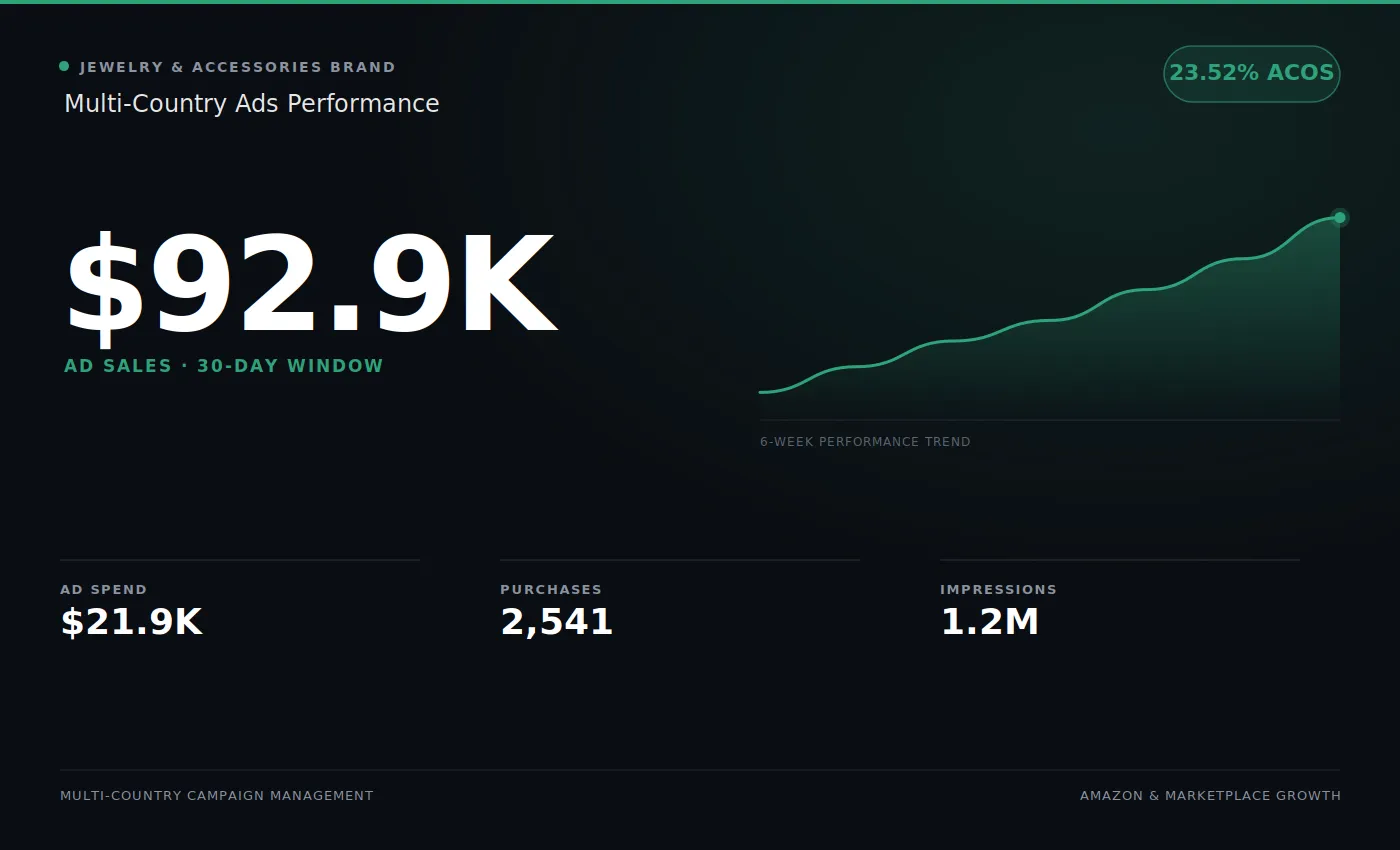
Sponsored AdsSponsored Ads · Jewelry
Taking on new accounts
Send the marketplace, the category and what is currently going wrong. You get a written read on advertising structure, catalog health and the first three things worth changing, before any engagement is discussed. One of us reads it, not a form queue.