Ask a vendor where their 1P margin goes and you will usually hear about cost price negotiations, or accruals, or freight. Those are the visible lines, so they get the attention.
The line that quietly takes more is the one nobody has been assigned: compliance deductions applied per shipment, each too small to trigger an investigation, posting on a lag long enough that by the time anyone notices, the process that caused them has run forty more times.
What actually triggers them
Chargebacks are not a judgement on your product. They are a fine for breaking a routing rule, and the rules are mechanical:
Routing. A shipment dispatched without a routing request, or against a routing instruction that was not followed. This is the most common one and among the most preventable.
Labelling. Carton labels missing, unreadable, or carrying data that does not match the ASN. A label printer running low on toner is a genuine and recurring cause of this.
Timing. Delivering outside the confirmed window. Early is penalised as well as late, which surprises people who assume early delivery is a courtesy.
ASN accuracy. The advance shipping notice describing a shipment that differs from what arrived — wrong carton count, wrong quantities, missing detail.
Packaging and prep. Carton dimensions, weight, overboxing, palletisation not to specification.
Notice what these have in common: every one is generated at the warehouse by a routine, not by a decision. That is the whole point.
Prevention beats disputes, and it is not close
Disputes have a window and an evidence bar. Where you genuinely hold the proof — a routing confirmation, dated carrier documents, an ASN record that matches the delivery — they are worth filing, and we do file them.
But the arithmetic is not in favour of treating disputes as the strategy. Avoiding the deduction costs less than winning it back. A dispute recovers one deduction, sometimes, after work. A corrected packing instruction stops that deduction on every PO from then on. One is a refund; the other is a rate change.
The accounts that get this under control are the ones that treat a chargeback as a defect report about a process, and route it to the person who runs that process, rather than to the person who reads the remittance.
Why it stays invisible
Three things conspire.
They post on a lag. The deduction lands well after the shipment, so cause and effect are separated by enough time that nobody connects them.
They are individually trivial. No single deduction is worth an escalation. It is only the reason-code total across a quarter that is alarming, and nobody produces that view by default.
They sit between two teams. The chargeback appears in a finance report. It is caused in a warehouse. Whoever reads it cannot fix it, and whoever can fix it never sees it. This is the same coordination gap that stalls accounts everywhere else, just wearing a different report.
The reconciliation that finds the money
Run it quarterly, not monthly, because the lag makes monthly views misleading:
- Pull remittance advices for the full quarter and total deductions by reason code.
- Rank reason codes by value, not by count. Twelve small labelling fines can matter less than three large routing ones.
- Trace the top two codes to a specific process step — which warehouse, which shift, which instruction sheet.
- Change that instruction, in writing, and confirm the next shipment under it.
- Dispute only what you can evidence, within the window, and stop treating the rest as a recovery project.
- Re-run next quarter and check whether the top codes moved. If they did not, the process change did not reach the floor.
The same reconciliation discipline applies to shortages and price claims, which are separate mechanisms but hide in the same lag and the same reports.
Contra-COGS and shipped COGS
Chargebacks are not the only deduction on a 1P remittance. The other large one is contra-COGS.
Shipped COGS is what Amazon paid you for the units it received: your agreed cost price times shipped units. It is the top line of a vendor P&L, and the figure Vendor Central’s sales reporting can show you on a cost basis.
Contra-COGS is everything negotiated back out of it: marketing and co-op allowances, damage allowances, freight allowances and similar terms agreed at the annual negotiation. It is usually taken as a percentage of shipped COGS, so it grows with the account whether or not the money it funds is doing anything. On Amazon’s side of the ledger, the same terms raise its own margin measure, Net PPM.
The two sit side by side in the same remittance, which is why they get confused. They behave differently, though:
- Chargebacks are operational. They are fines for how a shipment was prepared, and the reconciliation above reduces them.
- Contra-COGS is contractual. It is fixed at negotiation, and the only time to reduce it is the next annual vendor negotiation, with the evidence ready.
Read net of both, a vendor account’s margin is often thinner than the shipped-COGS line suggests. That net figure is the one worth managing, and it is the one Vendor Central management reports against.
The number this protects
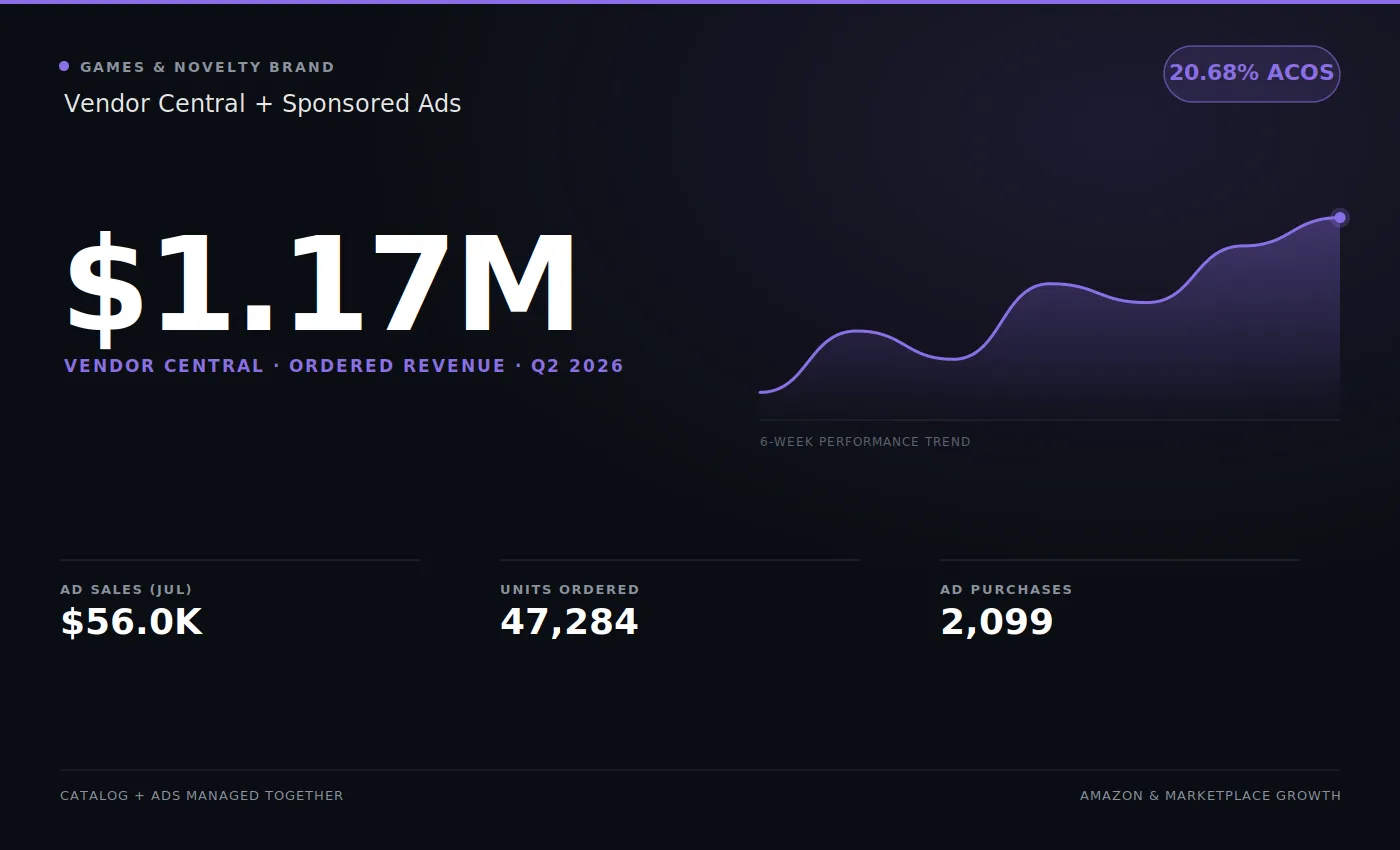
On the Vendor Central quarter in our portfolio, ordered revenue was $1,178,834.39 and shipped revenue $1,180,310.46 — within $1,476 of each other. That gap is the fill-rate story, and it is only readable because the operational side was not leaking in a dozen small places at once.
Ordered-versus-shipped and chargeback control are the same discipline viewed from two angles (the fill rate and PO confirmation guide covers the first): doing what the PO said, in the way the routing guide specified, on the date confirmed. That is most of what an Amazon Vendor Central expert actually does, and it is considerably less glamorous than the advertising conversation it funds.