Seller Central
Why Amazon accounts stop growing
A brand with a PPC freelancer, a copywriter, a shipping VA and an account-health VA has four competent people and one structural problem.
7 min read
Service
Full-lifecycle Amazon operations across nine marketplaces, coordinating catalog, advertising, inventory and pricing in one view.
In practice
This is for brands that sell on Amazon. Not as a side channel, not as a second storefront. As an actual business line that answers to revenue, margin and growth.
Most Amazon “accounts” struggle not because any single lever is wrong, but because no one is operating the account as a whole. Ads run against listings that are structurally weak. Inventory is planned without reference to what advertising just proved. Pricing changes ignore how they land on Buy Box position and ad efficiency simultaneously. The result is a portfolio of locally optimal mistakes.
Account management here means one operator with full, scoped access across catalog, advertising, inventory and account health. Not four contractors passing work off to each other. The same person sees what moves, why it moved, and what gets done about it — every week.
Catalog and listings are correct before anything is advertised. Variation families structured the way customers shop, images meeting Amazon’s technical requirements, backend keywords doing work rather than repeating the title. That discipline on its own is listing optimization.
The channel underneath determines which levers exist at all. Seller Central management covers catalog, advertising, inventory, pricing and Buy Box inside your own seller account. Vendor Central management covers purchase orders, fill rate, chargebacks and cost negotiation on a first-party catalog, where retail price is Amazon’s decision rather than yours.
Inventory is planned as an advertising constraint. Stock cover drives bid strategy. Deep cover means push. Thin cover means protect rank rather than chase volume, because winning a rank position you cannot hold costs twice — once to buy, once to rebuild after the stockout.
Pricing and Buy Box are monitored as first-class metrics, not checked when sales drop. Price changes are made with awareness of what they do to advertising efficiency and to active deals or coupons.
Account health is checked on a fixed cadence. Almost every expensive account-health problem started as a cheap one nobody was watching.
What this costs depends on channel, catalog size and marketplaces. How Amazon account management pricing is quoted explains each factor.
Each specialist page below owns its discipline in full depth. This page owns the handoffs between them — the place most accounts actually lose money, because nobody is watching the seam.
| Decision | Owned by the specialist page | What account management adds |
|---|---|---|
| Bid ceiling on a campaign | PPC management sets it from contribution margin | Adjusted the same week stock cover changes, not at the next scheduled review |
| Which variation is the parent | Listing optimization decides the structure | Checked against what advertising is actually driving traffic to before the split ships |
| Accepting a purchase order | Vendor Central management runs the PO decision | Weighed against what the same SKU is doing on Seller Central, where both channels exist |
| A price change | Seller Central management sets it against Buy Box | Checked against active ad spend before it ships, so a price cut doesn’t silently blow through an ACOS target |
| Restock timing | FBA management plans the shipment | Timed against the campaign calendar, not against warehouse capacity alone |
None of this shows up as a line item on an invoice. It shows up as the difference between five channels each doing their own job correctly and an account that compounds.
Accounts are operated in the United States, United Kingdom, Canada, Mexico, Germany, Italy, France, Sweden and the Netherlands. Each marketplace has its own search behaviour, competitive density and compliance requirements. Operating them as one account means knowing which levers travel and which do not.
A weekly written summary covering sales and advertising movement, inventory position, account health status, and what is planned next. Monthly, a deeper read on category position and where the next increment of growth is most likely to come from.
Engagements start with an Amazon account audit: the constraint gets named before anything is scoped.
How we approach the parts of this service that decide whether it pays.
Seller Central
A brand with a PPC freelancer, a copywriter, a shipping VA and an account-health VA has four competent people and one structural problem.
7 min read
Amazon PPC
Most underperforming ad accounts are not badly bid. They are structured so that good bidding decisions are impossible to make.
7 min read
Amazon FBA
The lost margin on units you could not sell is the smallest part of a stockout. The rank you have to rebuy is the expensive part.
7 min read
Common questions
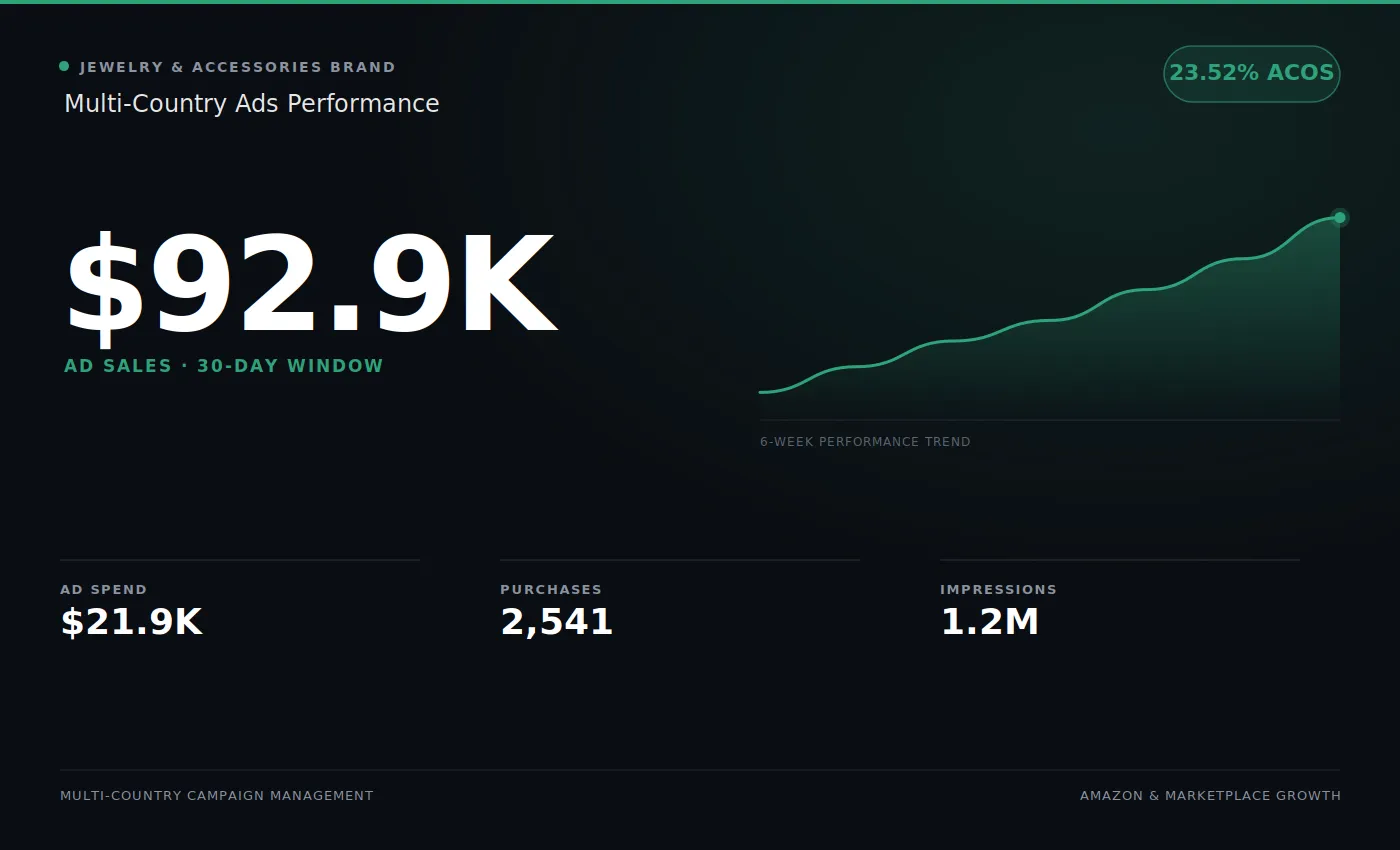
Sponsored AdsSponsored Ads · Jewelry
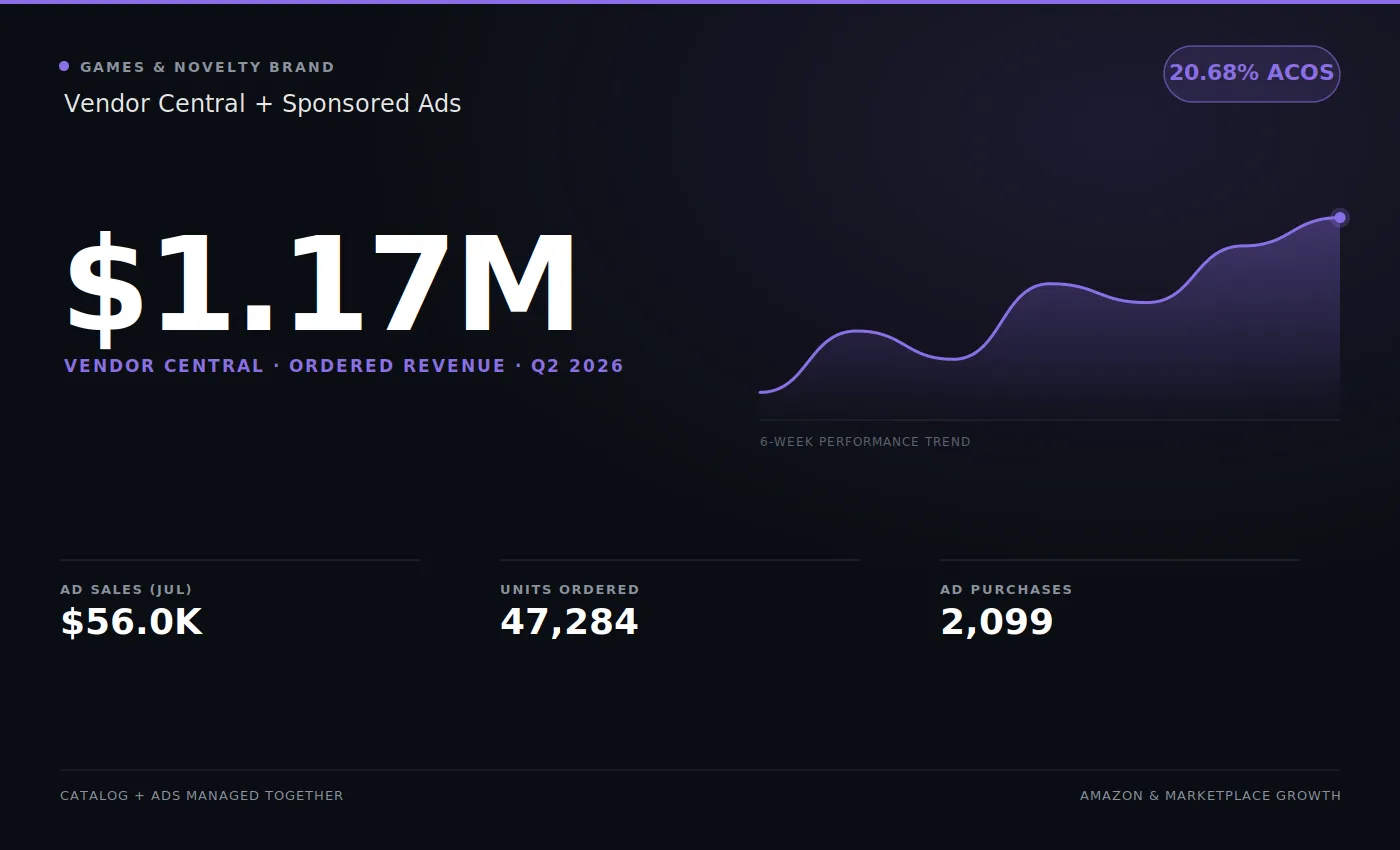
Vendor CentralVendor Central · Games & Novelty

Taking on new accounts
Send the marketplace, the category and what is currently going wrong. You get a written read on advertising structure, catalog health and the first three things worth changing, before any engagement is discussed. One of us reads it, not a form queue.