An Amazon PPC portfolio is a group of campaigns in Amazon Ads that shares one report line and, optionally, one budget cap.
Portfolios are the least discussed object in Amazon Ads and one of the few that can shut an entire product line off without anyone noticing for a week.
They are not a campaign type. They do not target anything, bid on anything or influence placement. A portfolio does exactly two things: it groups campaigns for reporting, and it can impose a spend cap across that group.
The reporting half is convenient. The cap is the half that has consequences.
How to create a portfolio in Amazon Ads
- In Campaign Manager, open Portfolios and choose Create portfolio.
- Name it after the decision it represents, usually a product line.
- Leave the budget cap off, or set a monthly recurring cap or a date-range cap.
- Add campaigns. Sponsored Products and Sponsored Brands are the ad types portfolios were built around, and Sponsored Display has been added since. Which ad types a portfolio budget cap applies to has changed more than once, so confirm what your own account shows before relying on a cap to stop a particular campaign type.
A campaign can belong to only one portfolio, and moving it between portfolios does not reset its history. A structured account ends up looking something like this (illustrative figures, not a client account):
| Portfolio | Budget cap | Campaigns | Spend (30 days) | ACOS |
|---|---|---|---|---|
| Core line — US | None | 14 | $8,400 | 22% |
| Launch — new SKU | $3,000, Oct 1–31 | 5 | $2,150 | 61% |
| Low-stock line | $1,200 monthly | 6 | $1,200 | 18% |
| Branded defence | None | 3 | $640 | 7% |
How the budget cap actually behaves
A campaign budget is a daily ceiling for one campaign. A portfolio budget is a ceiling for everything inside it, set either as a monthly recurring amount or across a date range.
When the portfolio cap is reached, every campaign it governs stops serving. Not the weakest ones. Not the ones over their own budget. All of them, including the campaign running at a 15% ACOS that you would happily fund three times over.
This is why a portfolio cap set once during a cautious month and never revisited is one of the more expensive things we find during an account audit. Spend flatlines mid-month, sales follow, and the reports underneath look fine because each individual campaign is still healthy — it simply stopped being allowed to run.
If you do not want that behaviour, leave the cap off. An uncapped portfolio is purely organisational and entirely safe.
Group by the decision, not by the ad type
The most common structure we inherit sorts portfolios by campaign type: one for Sponsored Products, one for Sponsored Brands, one for Sponsored Display.
It reads tidily and it is close to useless, because nobody makes budget decisions that way. You do not wake up and decide to spend less on Sponsored Brands. You decide to spend less on a product line that is short on stock, or more on the line you are pushing this quarter.
Portfolios should mirror the unit you make money and decisions on:
- Product line or sub-brand — the default, and correct for most accounts.
- Marketplace, where one account spans several. Budgets, margin and currency all differ, so reading them together is misleading.
- Launch versus established, when launches are deliberately run at a loss and you need that spend fenced off from the profitable base so it stops contaminating your blended numbers.
The test is simple: if you would never move budget between two groups, they belong in different portfolios. If you constantly move budget between two portfolios, they should probably be one.
Where portfolios earn their place
Three situations where they do real work:
Stock-constrained lines. When cover is thin, a portfolio cap is a hard stop on spending into inventory you cannot serve. It is a blunter instrument than adjusting bids by cover band, but it is the one that cannot be forgotten, because it enforces itself.
Launch budgets. A launch has a defined budget and a defined window. A date-range portfolio cap expresses exactly that, and stops a launch quietly becoming a permanent line item.
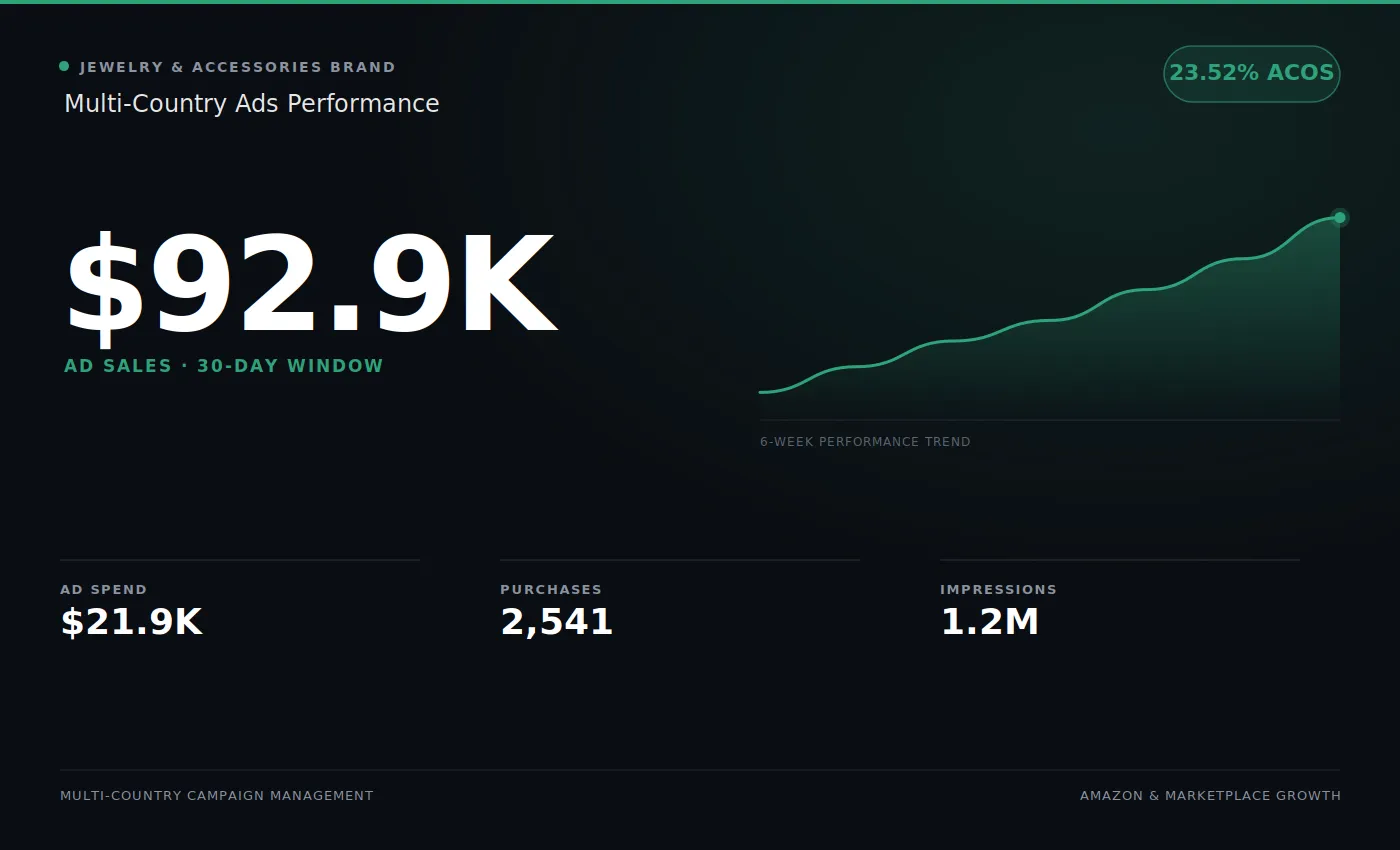
Multi-marketplace accounts. On the jewelry account in our portfolio, campaigns run across US, UK and DE. Reading those as one pooled number hides which marketplace is carrying which, and pooling their budgets means the cheapest clicks absorb the spend regardless of where the margin is.
What portfolios will not fix
They do not fix structure. If keywords are duplicated across campaigns, if search terms are never harvested, if match types overlap, a portfolio just draws a box around the problem and reports it more neatly.
They also do not replace bid governance. A cap tells you when to stop. It never tells you where the next dollar should go, which is the question that actually determines ACOS.
The order to fix things in is unchanged: get campaign structure right first, get search-term harvesting running, then use portfolios to fence the budget once there is something worth fencing.
The five-minute check
Open the portfolios tab and answer four questions:
- Which portfolios have a budget cap set at all?
- For each cap, what month was it set, and what has changed since?
- Has any portfolio hit its cap in the last 90 days — and did anyone know?
- Does each grouping match a decision you genuinely make, or a category that just sounds organised?
Most accounts we take over fail at least two of these. It costs nothing to fix and it is usually the fastest single recovery available, which is why it is a standing item in our Amazon PPC management.