Vendor Central
Vendor Central vs Seller Central
In Vendor Central you sell to Amazon. In Seller Central you sell through it. Almost every practical difference follows from that one sentence.
12 min read
Service
Purchase orders, fill rate, chargebacks, A+ content and Vine, plus reporting that separates ordered revenue from what actually shipped.
In practice
Amazon Vendor Central experts are rarer than Seller Central ones, because the skills do not transfer as neatly as the shared login suggests.
Vendor Central is a wholesale relationship dressed up as a web portal. Amazon buys from you, sets its own retail price, and decides how much to order. The controls you have are different from Seller Central and the failure modes are different too, which is why 1P accounts run by people who learned on 3P tend to underperform in the same predictable ways.
Purchase orders arrive on Amazon’s schedule and its quantities. Accepting orders you cannot fill damages your standing; rejecting orders you could have filled costs revenue. Managing that line, with visibility into your own supply position, is the core operational rhythm of a vendor account.
Ordered revenue is what Amazon asked for. Shipped revenue is what actually moved. Reading only the first number produces quarters that look strong and settle weak. I report both, together, always.
Annual vendor negotiations, cost price changes and promotional funding requests are where a large portion of vendor profitability is decided. These conversations go better with the account’s own performance data in front of you.
Routing violations, packaging non-compliance, ASN errors and shortage claims each have a specific root cause and a specific fix. Disputing them one at a time without correcting the upstream process means disputing them again next month.
A+ content, premium A+ where available, brand store structure and product video. On a 1P catalog these matter more than on 3P, because you cannot create a new listing to escape a weak one. The ASIN you have is the ASIN you improve.
I have directed A+ content with graphic designers, planned and edited Amazon product video, and run Vine enrolment and review monitoring on an established first-party apparel catalog.
Sponsored Products, Sponsored Brands and Sponsored Display all run against vendor catalogs, and the economics differ from 3P because your margin structure is a wholesale margin. Bids are set against that, not against a 3P contribution model borrowed from a different account.
The instinct that works on Seller Central is the instinct that costs money here, and it fails in four specific places.
You cannot relist your way out of a problem. On 3P, a broken listing can be superseded. On 1P, the ASIN you have is the ASIN you improve, which is why content quality compounds in a way it does not on a seller account.
You do not control retail price. Amazon prices to its own logic, which means margin modelling runs on cost price and terms rather than on a price you set. Bid ceilings follow from a wholesale margin, not a 3P contribution margin, and importing the latter produces bids that look conservative and are not.
Revenue is Amazon’s replenishment decision, not your sales effort. Advertising on 1P is a discovery and defence instrument on a catalog whose volume is primarily driven by purchase orders. On the published quarter below, the entire advertising layer accounted for roughly 4.8% of ordered revenue — which is the correct proportion for the role it plays, not a sign of underinvestment.
Chargebacks are a supply process, not a dispute queue. Routing violations, ASN errors and packaging non-compliance each recur until the upstream process changes. Disputing them individually without fixing the cause means disputing them again next month, indefinitely.
Three numbers, routinely collapsed into one, and the gap between them is where vendor quarters go wrong.
Ordered is what Amazon asked for. Shipped is what actually moved. Settled is what survives after chargebacks, shortage claims, co-op and promotional funding. A quarter reported on ordered revenue alone can look strong and land weak, and by the time the settlement data shows it, the operational cause is three months cold.
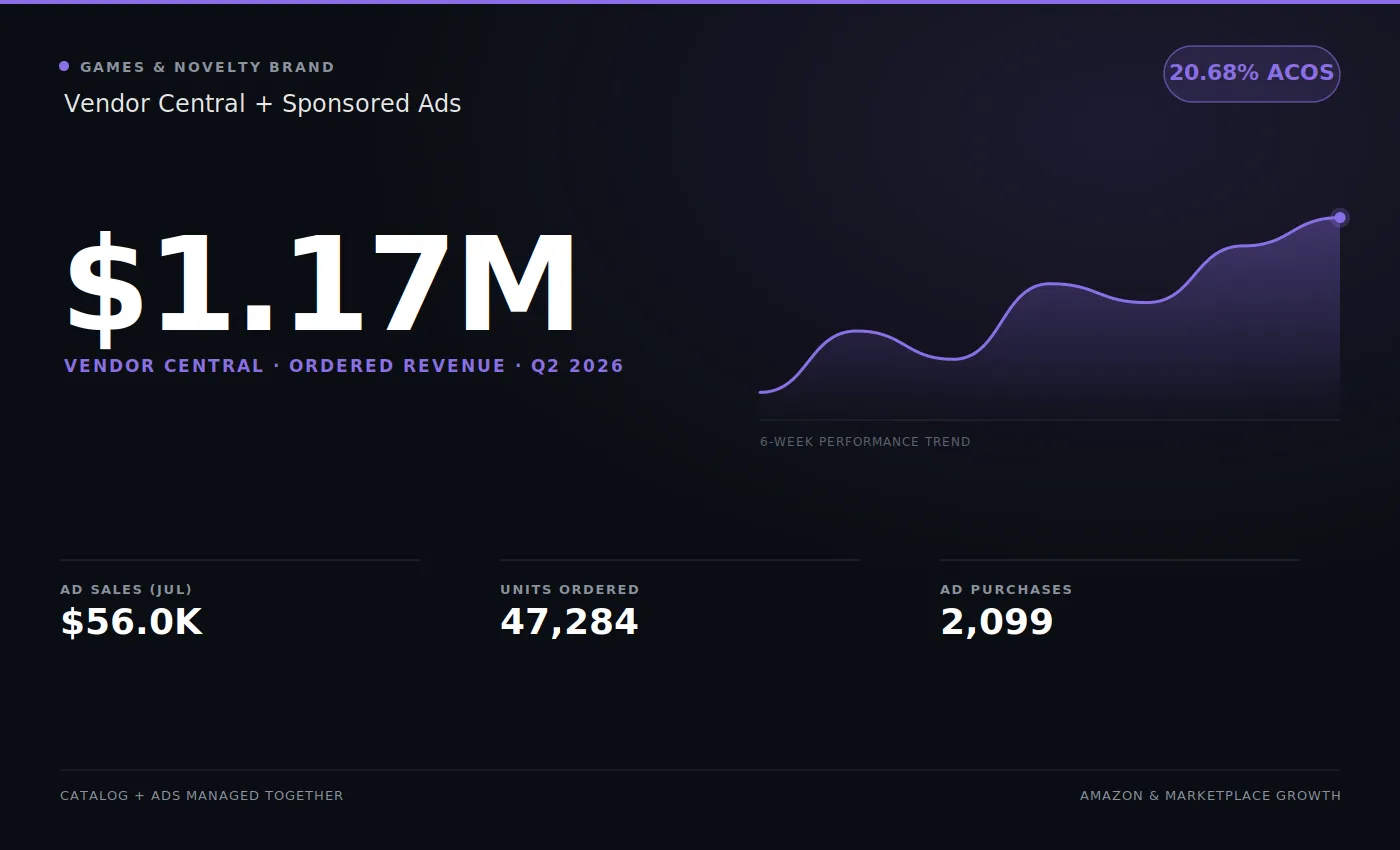
All three are reported together, always. In the published quarter for a games and novelty brand, roughly $1.18M in ordered revenue across about 47,300 units shipped within a tenth of a percent — which is the point of tracking it. That figure is only meaningful because the ordered number was being read against the shipped number continuously rather than reconciled at quarter end.
Sponsored Products, Sponsored Brands and Sponsored Display all run against a 1P catalog, and the economics are genuinely different rather than nominally different.
In the same published quarter, the advertising layer delivered around $56K in ad sales on about $11.6K of spend at 20.68% ACOS, across roughly 2,100 purchases. That ACOS was set against a wholesale margin structure and is comfortably profitable on it — and it is not directly comparable to the third-party ACOS figures elsewhere in the portfolio, which are held against a different margin entirely.
Comparing a 1P ACOS to a 3P ACOS without adjusting for that is the most common analytical error on hybrid accounts, and it usually results in a vendor advertising budget being cut for looking expensive when it was performing correctly.
A+ content, premium A+ where the brand qualifies, brand store structure and product video, planned around the fact that a 1P catalog cannot be escaped by relisting.
The work here has included directing A+ content with graphic designers, planning and editing Amazon product video, and running Vine enrolment with review monitoring on an established first-party apparel catalog. Vine in particular earns its place twice: as review volume on a new ASIN, and as an early quality signal, since Vine feedback frequently surfaces a sizing, packaging or expectation problem while correcting it is still cheap.
Purchase orders, fill rate, cost negotiation and content sit with me. The Sponsored Ads layer sits with Talha. The reconciliation between ordered, shipped and settled — and what a unit actually nets after chargebacks and funding — sits with Faris.
Vendor accounts punish handoffs more than seller accounts do, because a fill rate problem this month is an advertising problem next month and a chargeback is a supply-side defect wearing an Amazon label.
Week one is read-only: retail analytics, purchase order and fill rate history, the chargeback record by category, cost price and terms, and the advertising history against all of it.
The output is a written picture of three things — where fill rate is costing you standing, which chargeback categories are recurring and why, and whether the advertising is sized correctly for the role it plays on this catalog. The second of those is nearly always a process fix rather than a dispute strategy.
From week two, purchase order management runs on Amazon’s cadence with visibility into your supply position, chargeback root causes are corrected upstream, and reporting shows ordered against shipped every week rather than at quarter end.
Fill rate and chargeback trends read over a quarter, because they follow purchase order cycles. Advertising efficiency reads inside six weeks.
Ongoing management starts at $1,000 per month for a single marketplace, moving with catalog size and marketplace count. Fees are flat rather than a percentage of ordered revenue or ad spend.
If you would rather start with a diagnosis, the account audit is $500 and covers purchase order performance, chargeback exposure, content and advertising, with no obligation to take management afterward. For brands running both first and third-party catalogs, account management covers the cross-channel version.
How we approach the parts of this service that decide whether it pays.
Vendor Central
In Vendor Central you sell to Amazon. In Seller Central you sell through it. Almost every practical difference follows from that one sentence.
12 min read
Vendor Central
A 1P account rarely loses margin in one visible place. It loses it in small compliance deductions that nobody owns, applied per shipment, discovered a quarter later.
7 min read
Vendor Central
Most of a 1P vendor's margin for the coming year is decided in one negotiation. The vendors who come out of it well are the ones who walked in knowing their net margin per ASIN, what each allowance bought them, and where they would walk away.
8 min read
Vendor Central
Filing the request takes ten minutes. Getting it approved depends on everything you prepare before you file: the evidence, the effect on Amazon's margin, and what you do if the answer is no.
7 min read
Vendor Central
Fill rate is not decided in the warehouse. It is decided in the few minutes when someone confirms a purchase order, and the most common mistake is accepting quantities the business cannot ship.
9 min read
Vendor Central
Every vendor tracks its own margin. Amazon tracks its margin on you, and that number shapes how much it orders, how hard it pushes in the annual negotiation, and whether it keeps a product at all.
9 min read
Common questions
Vendor CentralVendor Central · Games & Novelty
Taking on new accounts
Send the marketplace, the category and what is currently going wrong. You get a written read on advertising structure, catalog health and the first three things worth changing, before any engagement is discussed. One of us reads it, not a form queue.