Most Amazon PPC advice is written for durable goods, not for food and beverage brands. Buy once, maybe replace in three years, judge the click on the order it produced. Applied to a consumable it will either lose you money or leave most of the growth on the table, usually both in sequence.
Three things change.
Shelf life is a bid ceiling
A consumable has an expiry date, and FBA will not let you sit on stock indefinitely against it. That limits how deep your cover can safely go, which limits how hard you can push velocity, which limits spend — regardless of how well the campaigns are performing.
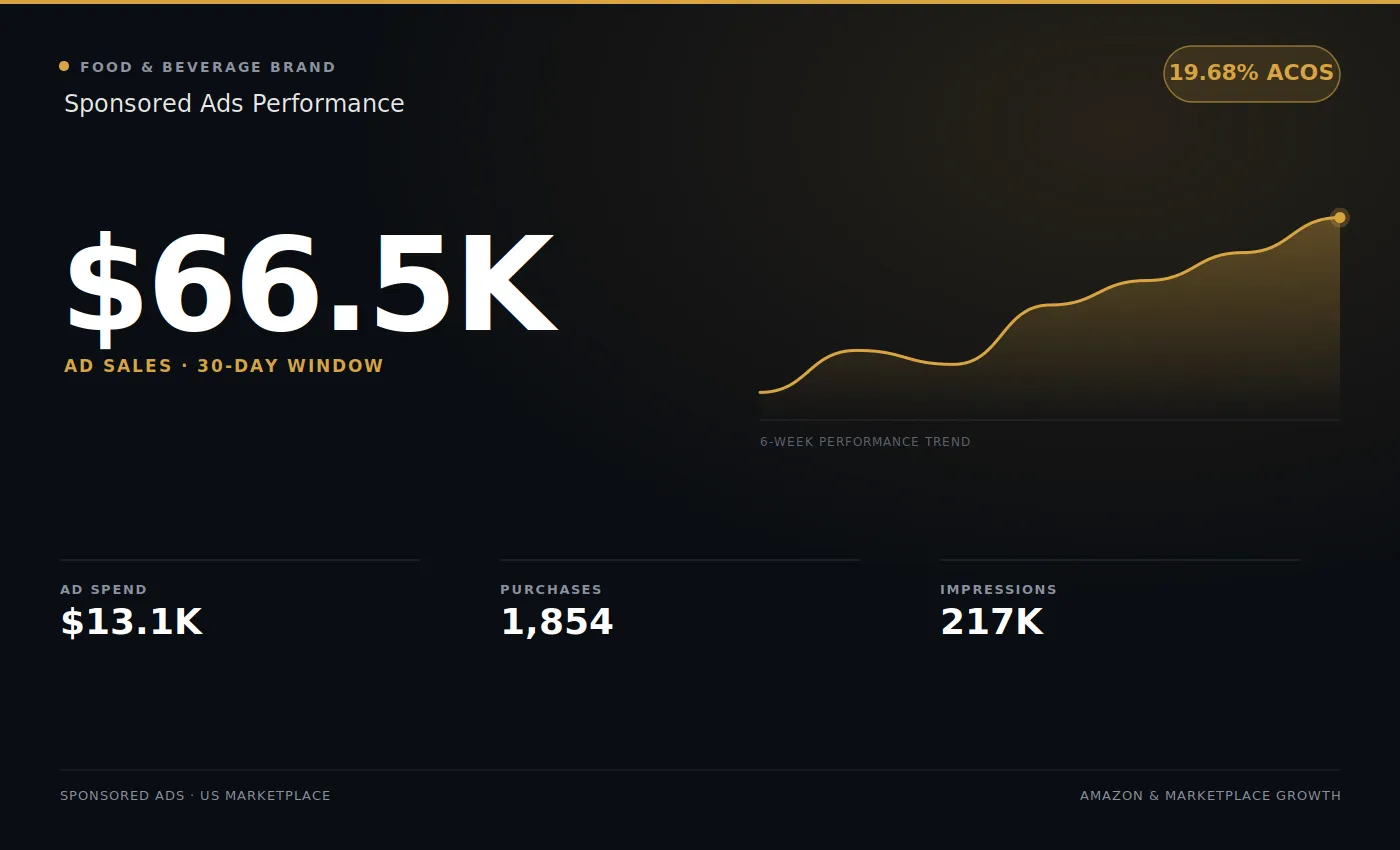
This is the uncomfortable version of a scaling constraint: the account is not held back by advertising skill, it is held back by production runs and dating. On the food and beverage account below, that ceiling is a permanent input to bid strategy rather than an occasional inventory conversation.
The practical consequence is that spend has to be paced against production cycles, not against a monthly budget number. A campaign allowed to find its own level will happily consume six weeks of cover in three.
The first order is not the whole order
If a customer buys once and never returns, the margin on that order is all a click can ever be worth. Break-even ACOS follows directly from contribution margin, and there is nothing further to argue about.
Consumables break that. If a meaningful share of buyers reorder, the value of acquiring one is the first order plus the ones that follow, and the ACOS you can afford on the first order rises accordingly.
Two cautions, because this is where the reasoning usually goes wrong:
Evidence the reorder rate; do not assume it. Repeat purchase behaviour is visible in Brand Analytics. A product in a category that usually repeats is not the same as a product that does. Flavour-led and novelty SKUs frequently do not.
Do not compound the allowance. Raising break-even ACOS on the strength of a second order, and then again on a third, produces a number that only works if every buyer becomes a lifelong customer. One additional order of allowance is defensible. Four is a spreadsheet talking.
The 19.68% ACOS on that 30-day period — $13,102.83 of spend against $66,578.15 of ad sales, 1,854 purchases — sits where it does because the repeat behaviour was measured first and the bids were set second.
Subscribe & Save hides your return
A subscription reorder involves no click and carries no ad attribution. The advertising console shows you the acquisition and none of the annuity.
So the campaign that builds your subscriber base is systematically undersold by the exact report you use to judge it. Cut it on campaign ACOS and you will remove the thing paying for the quarter.
This is the clearest case for reading the account on TACOS rather than ACOS: total ad spend against total sales, tracked as a trend. If TACOS falls while ad sales hold flat, the organic and subscription base is growing underneath, which is precisely what a consumable account is supposed to do.
Keywords behave differently too
Occasion beats feature. People search for the moment more than the specification — post-workout, pre-workout, office snack, gift box. Feature terms convert, but occasion terms are where the volume the category actually searches on sits.
Dietary qualifiers carry disproportionate intent. Gluten free, sugar free, keto, vegan, seed-oil free. Narrow, unglamorous, and they convert well above the head terms because the searcher has already disqualified most of the shelf.
Seasonality is sharper than the annual average implies. Gift-led and holiday-led demand concentrates into weeks. Bidding to a twelve-month mean underspends the peak and overspends the trough, and the restock has to be built backwards from those weeks anyway.
What we would check first
On any consumable account, in this order:
- Cover in weeks against expiry dating, per SKU. That number sets the ceiling everything else operates under.
- Measured reorder rate, from Brand Analytics, before break-even ACOS is touched.
- TACOS trend over 90 days, to see whether subscription and organic revenue is actually compounding.
- Campaigns judged on the wrong metric — specifically any subscriber-acquisition campaign being read on its own ACOS.
- Seasonal pacing, built backwards from the peak weeks including FBA receiving time.
None of it is exotic. It is the difference between running ads for a consumable and running ads at a consumable, and it is how the Amazon PPC management side of a food and beverage account gets structured before a single bid is changed.