Vendor Central is a wholesale relationship dressed up as a web portal. Amazon buys from you, sets its own retail price, and decides how much to order. Seller Central is a storefront: you sell to the customer, you set the price, you carry the inventory risk.
Almost every practical difference between the two follows from that one distinction. Operators who learned on one and inherit the other tend to reach for levers that no longer exist.
The differences that actually change your day
| Seller Central (3P) | Vendor Central (1P) | |
|---|---|---|
| Who sells to the customer | You | Amazon |
| Retail price | You set it | Amazon sets it |
| Buy Box | You compete for it | Not applicable |
| Margin | Retail margin, higher per unit | Wholesale margin, lower per unit |
| Inventory risk | Yours until it sells | Transfers on purchase order |
| Payment | Every two weeks | Net terms, 30–90 days |
| Catalog changes | Immediate, self-service | Slower, often case-based |
| Fixing a bad listing | Create a new one | Improve the ASIN you have |
| Access | Open registration | Invitation only |
| Main failure mode | Buy Box loss, account health | Chargebacks, unfilled POs |
What you give up moving to 1P
Price control. Amazon can discount to match a competitor and will not consult you. If your brand depends on price positioning, or you have MAP agreements with other retailers, this is a serious constraint rather than an inconvenience.
Speed. In Seller Central a listing change takes minutes. In Vendor Central catalog changes route through processes that can take days and sometimes need a case.
The escape hatch. On 3P, a listing with accumulated bad history can be replaced. On 1P, the ASIN you have is the ASIN you improve. This single constraint is why content quality matters more on vendor accounts than most operators expect, and why first-party engagements weight so heavily toward A+ content, video and review-driven content maintenance.
What you gain
Volume. Amazon’s replenishment ordering can move quantities that would take a 3P account a long time to build.
The Amazon sold-by signal. “Ships from and sold by Amazon.com” still converts measurably better for some categories and some customers.
Inventory risk transfer. Once a purchase order is fulfilled, the units are Amazon’s problem.
Simpler operations. No Buy Box monitoring, no repricer, no seller-side customer service.
What each channel actually costs you
The comparison most brands run is retail margin against wholesale margin. Right instinct, wrong arithmetic — the two channels take their cut in completely different places, and only one of them publishes its rates.
On Seller Central the deductions are legible. A referral fee of roughly 8–15% depending on category, FBA fulfilment charged per unit by size and weight, monthly storage, and surcharges on anything that sits too long. You can model all of it before you list the product, and it does not change without an announcement.
On Vendor Central almost none of that applies, and something less legible replaces it. Amazon buys at a negotiated cost price and then accrues against it: a marketing or co-op allowance, a damage allowance, freight terms, an early-payment discount if you take one. Each is a point or two. Together they routinely exceed what a referral fee would have cost — and unlike the referral fee they are negotiated, revisited annually, and easy to agree to one at a time without anyone modelling the total.
The figure to hold a vendor agreement against is your net margin after terms: what remains after every accrual, not the cost price at the top of the contract. An account that looks healthy at the quoted cost price and underwater after terms is the most common surprise in a first-party P&L. Amazon measures the same deal from the other side, as Net PPM: its own margin on your products, which your terms increase.
Then there is the cash. Seller Central settles on a roughly fortnightly cycle. Vendor Central pays on net terms — commonly 30, 60 or 90 days from invoice. On a growing account that gap is working capital you are funding yourself: you manufacture, you ship, you wait a quarter. Brands that model 1P on margin alone and never on cash timing tend to hit the wall at exactly the point the channel starts working.
Getting into Vendor Central, and why an invitation is not a plan
Vendor Central is invitation only. Invitations come from Amazon’s retail teams, generally to brands already selling well in 3P, already visible at trade level, or already large enough elsewhere that Amazon wants the assortment. There is no application form. Vendors who tell you they applied were almost always recruited.
The part most comparisons leave out: Amazon has spent years narrowing its vendor base. Smaller vendors have been moved back to third-party selling, sometimes with little notice and no meaningful appeal. Being invited is not a permanent status.
That is not an argument against 1P. It is an argument against treating 1P as a destination. Brands that handle this well keep a functioning Seller Central presence whether or not they are leaning on it this quarter, because maintaining one is cheap and building one under time pressure is not.
The number that tells you the truth about a 1P account
Vendor Central reports ordered revenue prominently. It is the figure that appears in decks and gets quoted in meetings. It is also not what you were paid.
- Ordered revenue is what Amazon requested through purchase orders.
- Shipped revenue is what actually left your warehouse and was received.
The gap between them is fill rate expressed in currency, and it is the most diagnostic figure on a vendor account. A wide gap means purchase orders were accepted and not fulfilled, which costs the revenue immediately and, more seriously, teaches Amazon’s replenishment systems to order less from you next time.
Vendor accounts that report only ordered revenue are reporting demand, not performance. Demand is useful information. It is not a result.
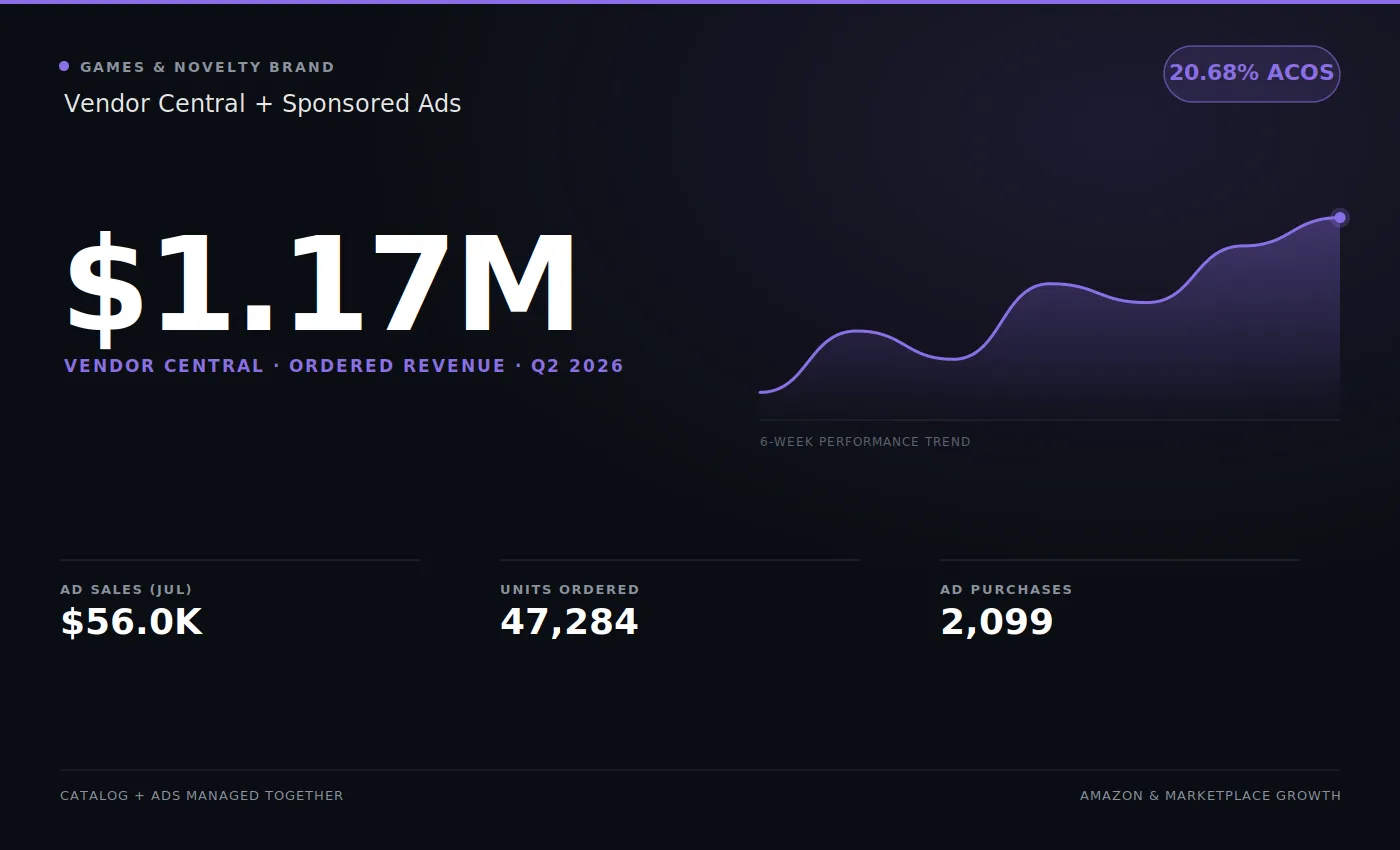
In a quarter I published in full, ordered and shipped revenue both landed at roughly $1.18M, within about a tenth of a percent of each other, with shipped marginally ahead from orders spanning the period boundary. That alignment is the operational point of the case study, not the headline number.
Chargebacks are process defects, not a disputes queue
Routing violations, packaging non-compliance, ASN errors, shortage claims. Most vendors treat these as something to appeal, one at a time, forever.
Nearly every recurring chargeback category has a specific upstream cause. Routing violations usually mean a scheduling process that does not match Amazon’s requirements. Packaging non-compliance usually means a spec that never reached the manufacturer. ASN errors usually mean a data handoff that is manual and should not be.
Disputing without fixing the cause means disputing the same thing next month, permanently, as a cost of doing business that did not need to be one. Where the margin goes on chargebacks works through the categories one at a time.
Advertising works differently on 1P
Sponsored Products, Sponsored Brands and Sponsored Display all run against vendor catalogs. The economics differ because your margin is a wholesale margin, so bid ceilings calculated from a 3P contribution model will be badly wrong.
There is also a difference of role. On a 1P catalog with meaningful replenishment volume, advertising is generally not the primary revenue engine. It surfaces new products, defends established ASINs and supports launches. In the quarter above, advertising delivered roughly $56K in ad sales on about $11.6K of spend at 20.68% ACOS, which is roughly 4.8% of ordered revenue. Judging that against a 3P benchmark produces the wrong conclusion.
Choosing, or running both
Vendor Central suits an established brand with reliable supply, wholesale margins that work, and no hard requirement for price control.
Seller Central suits a brand that needs to control price, iterate on the catalog quickly, or protect a higher per-unit margin.
Many brands run both, and the split is a product decision rather than a channel preference.
The trap is the same ASIN in both. That does not give you two listings. It gives you one detail page with two sellers on it, and one of them is Amazon — who wins that Buy Box most of the time. Your third-party units stop selling while first-party purchase orders keep arriving, and you are now paying storage on inventory that has quietly stopped moving.
A split that holds:
- 1P — stable, high-volume lines where replenishment ordering is worth more to you than price control.
- 3P — launches, seasonal lines, anything carrying MAP exposure, anything you need to be able to reprice this week.
- Neither — the same ASIN in both. If a product genuinely has to change channel, move it deliberately and let one side go quiet before the other starts.
The reporting standard worth holding
Any vendor report should show ordered revenue, ordered units and shipped revenue together, every time, with advertising reported as its own layer rather than folded into the retail number.
Anything less is a selective read, and on 1P, the selective read is always the flattering one.
Deciding between the two channels, or running both without letting them drift apart, is the daily work of our Amazon Vendor Central management.