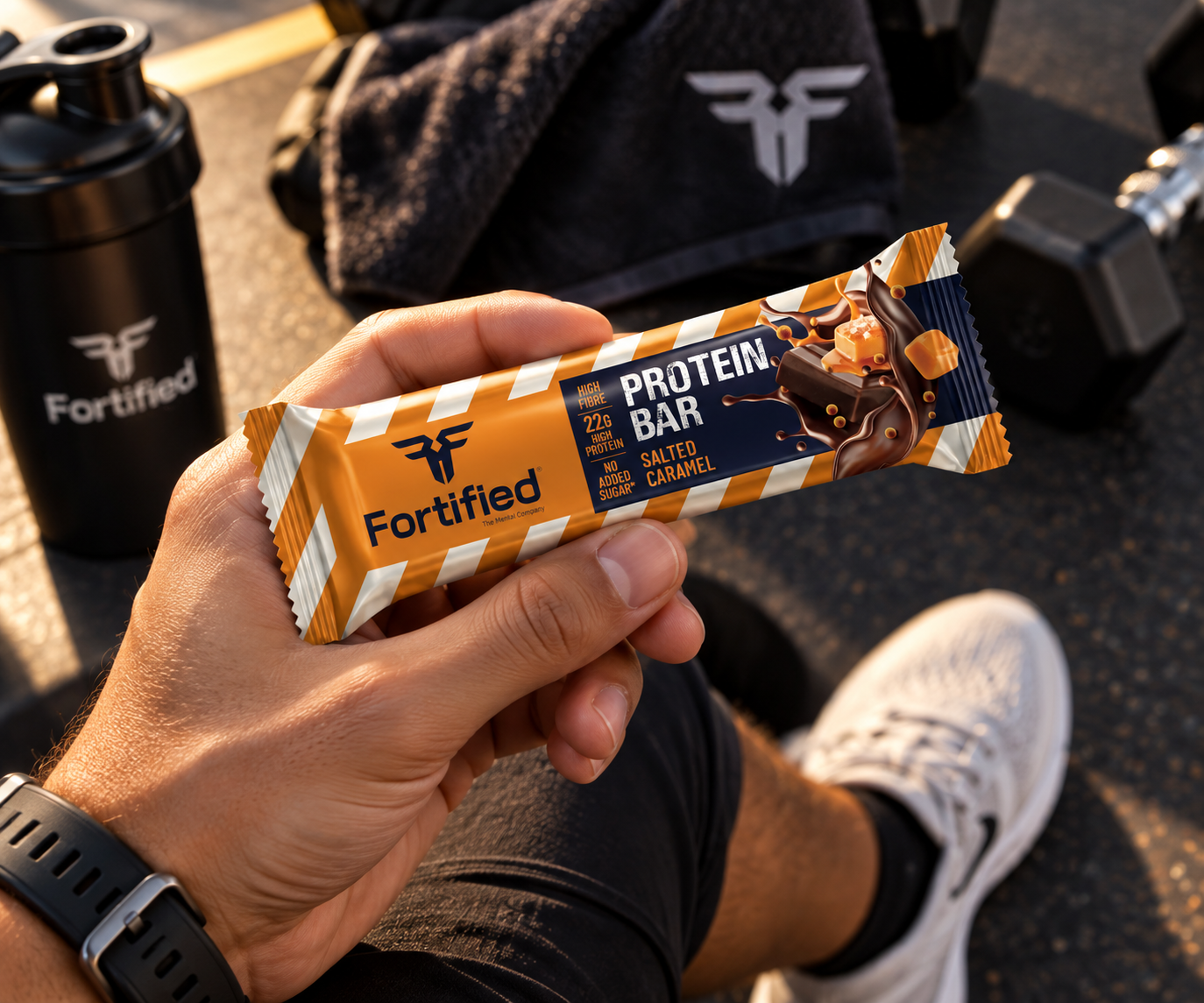
Fortified
01 / 19The opportunity
Fortified

Amazon UK proposal

Listing and
PPC growth plan

A practical proposal to improve the product page, build relevant search visibility and manage advertising against commercial targets.

Scroll to read

02 / The product page

A rebuilt Salted Caramel listing

Not a mock-up — the working page below is built the way I would build it: full creative stack, product video, buying options, comparison table and complete A+ content. Scroll inside it.

fortified / salted caramel — concept page
Open in new tab

03 / Why the page is built this way

Four jobs the listing has to do

Explain the product

Flavour, 22g of protein and the reason to choose Fortified are stated above the fold, where the decision to keep reading is made.

Carry the creative

A complete image stack, a product video and brand-led A+ modules give a shopper enough to decide without leaving the page.

Make the offer comparable

Pack sizes, flavours and a comparison table let a shopper weigh Fortified against the alternatives already open in another tab.

Stay truthful

Every claim shown here is illustrative. Final copy is written from confirmed nutrition data, brand guidelines and keyword research.

Snapshot concept. Confirm current product claims, pack configuration and advertising policy before publication.

The PPC strategy Amazon UK

PPC PROPOSAL

A focused route to generic visibility

“Protein bars” requires an estimated 720 weekly units to compete for page one. I would start with relevant queries that Fortified can realistically influence.

MY RECOMMENDATION

Build rank on specific high-intent searches first. Expand into larger category terms once the listing converts consistently.

DataDive estimates, not ranking guarantees. Listing quality, price, reviews and conversion also affect organic rank.

MARKET POSITION

Almost no generic search visibility

PAGE-ONE SEARCH VOLUME EXPOSURE

Grenade522,921
Fortified2,500
209×

more search exposure
for Grenade in this snapshot

9/10

of Fortified’s page-one keywords contain Grenade or FULFIL brand terms.

Amazon shows a competitive relationship, but Fortified has very little generic category authority.

Price
£29.88
Above £21 niche median
42.3%
Reviews
15
Estimated 30-day sales
4
Listing age
5 months

DataDive competitor export. 10 page-one terms = 3% of tracked keywords. Estimated 30-day revenue: £120. Search exposure is volume, not revenue.

SEARCH STRATEGY

The proposed keyword sequence

Search queryMonthly SVRelevancyLaunch scoreFortifiedGrenadeFULFILAction
salted caramel protein bars25067%1#4012Start
20g protein bars25073%1—12Start
protein chocolate bar69573%3—25Start
high protein bars2,06380%8#13818Start
protein bars low sugar2,98387%10—24Pack check
low sugar protein bars1,91773%8—16Pack check
high protein snacks5,58553%31—316Later
protein bar22,14767%100—18Measure
protein bars144,09160%720—19Measure
258 searches per Launch Score unit
high protein bars
298 searches per Launch Score unit
protein bars low sugar
200 searches per Launch Score unit
protein bars

DataDive snapshot. SV = estimated monthly searches. Brand columns show organic rank. “—” = not ranked in the export. Launch Score is directional.

Fortified Salted Caramel protein bar conceptSalted Caramel / concept creative

FIRST EXACT-MATCH TARGET

“salted caramel
protein bars”

Organic rank
#40
Monthly searches
250
Launch Score
1

Fortified already ranks for this query. Support the existing relevance before buying harder category traffic.

Sponsored Products ExactSalted Caramel child ASINMatching flavour and PDP message

Watch: impressions, CTR, CVR, organic rank and Search Query Performance share.

Grenade ranks #1, FULFIL #2. Rank #40 is an observed position, not proof of page one. Evaluate rank improvement alongside economical orders.

FIRST GENERIC TARGET

“High protein bars” fits the product

22gprotein188kcal per bar

Fortified’s stated protein per calorie is higher than these comparison variants.

Current rank
#138
Monthly SV
2,063
Relevancy
80%
Launch Score
8

GRAMS OF PROTEIN PER 100 KCAL

Fortified22g / 188 kcal
11.70
Barebells20g / 190 kcal
10.53
FULFIL20g / 204 kcal
9.80
Grenade21g / 222 kcal
9.46
PhD22g / 246 kcal
8.94

Target the shopper who values protein density. Then use actual CVR to test the proposition.

Supplied nutrition research: Salted Caramel for Grenade/FULFIL, Cookies & Cream for Barebells/PhD. Fortified Amazon listing: 22g / 188 kcal. Confirm current packs before final claims.

CONDITIONAL KEYWORD EXPANSION

4,900 searches worth validating

protein bars low sugar

2,983 monthly SV87% relevancy10 Launch Score

low sugar protein bars

1,917 monthly SV73% relevancy8 Launch Score

Evaluate each query separately. The scores do not combine into one sales requirement.

BEFORE LAUNCH

The final nutrition panel needs confirmation

Older DTC formulation21g / 194 kcal1.6g sugars per 62g = 2.58g / 100g
Amazon-facing formulation22g / 188 kcalCurrent sugar content needs pack verification
Low-calorie terms stay out of the plan

“low calorie protein bars” 1,521 SV / LS 5, “protein bars low calorie” 1,181 / 4, “protein bar low calorie” 784 / 3. Attractive demand does not resolve product-claim suitability. Sugar-free also remains excluded.

The supplied research distinguishes low sugars, sugars-free, no added sugars and low energy. Full thresholds appear in the research notes and require source verification before launch.

SPONSORED PRODUCTS / PRODUCT TARGETING

Barebells is the closest price comparison

Fortified: £29.88 per box, 15 reviews, 22g protein / 188 kcal.

Test orderPriceFortified premiumReviews30-day salesProtein / kcal
01BarebellsClosest price. First PDP test.£28.92+3.3%27871420g / 190 kcal
02FULFILSeparate campaign to measure the price and review gap.£23.99+24.6%1,9767,82220g / 204 kcal
03PhDFortified has 58 fewer calories, but costs £9.70 more per box.£20.18+48.1%1,8271,10822g / 246 kcal
04GrenadePDP tests before aggressive brand searches.£19.12+56.3%65634,79321g / 222 kcal
One competitor campaign per comparison

Use ASIN-level bids. Measure the cost of each price and review disadvantage before expanding to Huel, N!CK’S or other relevant high-protein products.

DataDive box-price snapshot and estimated sales. Compare current offers and pack sizes before launch. FULFIL ASIN: B07HWHNMHP. Nutrition refers to the supplied comparison variants.

COMPETITOR INTENT

A product-page visit differs from a brand search

GRENADE

Known brand.
656 reviews.
£19.12 per box.

Fortified costs 56.3% more in the snapshot. Grenade also leads “protein bars”, “protein bar” and “high protein bars”.

On a Grenade PDP

The shopper is comparing a product. Test an ASIN placement first.

Searching “grenade protein bars”

The shopper may specifically want Grenade. Isolate this intent and bid separately.

WARRIOR / LOWER PRIORITY

£12

At this price, the shopper proposition is very different from Fortified’s.

211 / 56advertised keywords / Top of Search terms
136 / 34second Warrior ASIN

Avoid aggressive launch spending here. Nature Valley and Nakd are also lower priorities because their traffic includes broader snack intent.

DataDive observed advertising snapshot. Warrior B07F6SVZW9: 211 advertised keywords. A zero count for another brand does not establish that it never advertises.

INITIAL TEST BUDGET

Exact-match searches receive the largest share

I would place 35% of the initial budget behind the most relevant exact targets. Final daily spend depends on margin and account performance.

01Manual exact
35%

High protein bars, 20g protein bars, protein chocolate bar. Low sugar after pack confirmation.

02Product targeting
20%

Barebells, FULFIL, PhD, then Grenade. Separate campaigns and ASIN-level bids.

03Automatic discovery
15%

Prioritise close match and substitutes. Restrain loose match and complements.

04Flavour exact
10%

Salted Caramel, Cookie Dough and White Chocolate Peanut. Each query to its matching child.

05Phrase discovery
10%

High protein bar, protein bar, protein chocolate and protein snack. Harvest converting queries.

06Core category
5%

Protein bar and protein bars. Measure CPC, CTR and CVR before a ranking push.

07Competitor brand searches
5%

Grenade, FULFIL, Barebells and PhD. Separate from PDP targeting.

Proposed allocation totals 100%. Core-category and competitor-brand experiments each receive 5% so they cannot absorb the launch budget.

CAMPAIGN STRUCTURE

Discovery needs separate controls

15% / AUTOMATIC

Close matchPrioritise
SubstitutesPrioritise
Loose matchRestrain
ComplementsRestrain

Set bids independently for all four groups. Review actual search terms before raising discovery spend.

10% / FLAVOUR EXACT

Salted Caramel querySalted Caramel child
Cookie Dough queryCookie Dough child
White Chocolate Peanut queryMatching child

The advertised child and the PDP should match the shopper’s flavour.

10% / PHRASE DISCOVERY

high protein bar / protein bar / protein chocolate / protein snack

Convert winning search terms into controlled exact targets.

Proposed Sponsored Products structure. Auto group and phrase performance must come from Advertising Console, not the external keyword export.

SEARCH-TERM CONTROL

Traffic I would exclude

Outlier queryMonthly SVRelevancy
snacks107,32313%
protein83,37527%
healthy snacks37,26820%
breakfast bar20,67413%
low calorie snacks16,26813%
gluten free snacks15,66513%
snack12,79620%
breakfast bars11,03213%
vegan snacks6,02413%

Exclude demonstrably wrong intent

vegan, dairy-free, gluten-free, soy-free, sugar-free, keto, granola, cereal bars, breakfast bars, gummies

Apply exclusions where the product cannot meet the intent. Use the search-term report to add negatives and promote converting queries.

KEEP THE RELEVANT LONG TAIL“high protein snacks”

5,585 monthly searches. Do not phrase-negative “snacks” across the account.

DataDive Outlier export. Relevance is a competitor-based signal. Validate actual customer intent and product suitability before selecting negative match types.

BID MANAGEMENT

Bid limits tied to contribution

Target ACoSfrom contribution margin
×
Conversion ratefrom observed orders / clicks
×
Average order valuefrom actual paid orders
=
CPC ceilingindicative maximum bid input

Inputs we need

COGS, Amazon fees, selling price and margin requirements. Actual CVR, historical CPC, current suggested bids and break-even ACoS.

Use decimal rates in the calculation. The DataDive export shows zero in Suggested Bid & Range.

Discovery starts down-only

Use live Amazon auction guidance as an initial input, constrained by product economics and conservative bidding.

Move proven converting queries into winner campaigns before testing dynamic up-and-down bidding.

Exact bidsTBDTarget ACoSTBDDaily budgetTBD

No fabricated £-per-click targets. Confirm contribution after Amazon fees and product costs before finalising the launch settings.

PLACEMENT MANAGEMENT

Placement multipliers follow performance

15 reviews42% above the niche median price

Buying the first position does not resolve Fortified’s current conversion disadvantages.

Compare placementsCPCCVRACoS
Top of SearchMeasureMeasureMeasure
Rest of SearchMeasureMeasureMeasure
Product PagesMeasureMeasureMeasure
Start with neutral placement adjustments

Increase multipliers where the placement report shows better economics. Product-page conquest may beat broad-category Top of Search, but the account needs to prove it.

Proposed test, not a performance forecast. Review placement CPC, CVR and ACoS with adequate data before changing multipliers.

MEASUREMENT

Rank investment and profit need separate reports

01

Rank investment

Example: “high protein bars”
Current rank #138, Launch Score 8

  • Search query and paid orders
  • Total orders and organic rank movement
  • DataDive / SQP visibility
  • Incremental sales cost

Is the temporary investment creating stronger organic visibility?

02

Profit harvesting

Example: a competitor PDP target
Limited direct generic-ranking rationale

  • CPC, CTR and conversion rate
  • ACoS and ROAS
  • Contribution after ad spend
  • TACoS alongside total account sales

Does the target contribute profit at the agreed acquisition cost?

Agree investment limits and review windows before launch. Neither a blanket ACoS cut nor an unlimited “ranking spend” label is an adequate decision rule.

SELLER CENTRAL & ADVERTISING CONSOLE

Account access shows where shoppers drop out

01

Impressions

Good impression share,
weak click share?

Review image, price
and proposition.
02

Clicks

Decent click share,
weak cart-add share?

Review the PDP
and perceived value.
03

Cart adds

Strong cart-add share,
weak purchase share?

Review offer, delivery,
price and reviews.
04

Purchases

Compare at query,
brand and ASIN level.

Validate the winning
child and competitor thesis.

Seller Central

Search Query Performance, catalogue funnel and child-ASIN traffic / conversion. Use query detail and top-ASIN comparisons where available.

Advertising Console

Search Term, Targeting, Advertised Product, Placement and Performance over Time reports. Check existing negatives, bid history, campaign settings and budget limits.

These are diagnostic hypotheses. SQP provides query volume and funnel signals. Actual reports establish CPC, competitor conversion, best child ASINs, placement value, ACoS and TACoS.

PROPOSED EXECUTION

The launch plan

Each stage has a clear decision point. Timing depends on account access, listing readiness and order volume.

  1. 01

    Account & product validation

    Obtain reports. Confirm the current pack, child ASINs, listing readiness and contribution economics.

    Before spending: claims and bid limits confirmed.
  2. 02

    Controlled campaign launch

    Activate relevant exact, flavour and PDP tests. Add restrained discovery, separate bids and unsuitable-intent negatives.

    Before expanding: sufficient query and placement data.
  3. 03

    Search-term & conversion review

    Harvest exact winners. Diagnose funnel losses. Reduce waste and compare each competitor’s acquisition economics.

    Before scaling: repeatable conversion within agreed limits.
  4. 04

    Budget & ranking expansion

    Test winner bids and placements. Graduate to harder queries as conversion and sales velocity improve.

    Continue when incremental orders and rank justify the spend.
First action

Seller Central + Advertising Console access, final nutrition panel, and product economics.

External research establishes the direction. First-party account data determines final bids, budgets and expansion decisions.

The ranking hurdle

FORTIFIED / PPC STRATEGY

All slides

SUPPLIED STRATEGY / SUPPORTING DETAIL

Research notes

Full original research, including every table and decision rationale.

Snapshot data, not live performance. Original source links were absent from the pasted research. Confirm current product claims and policy before launch. Read 2,500 page-one exposure as search volume, not £. Rank #40 does not confirm page one, and low-sugar Launch Scores are separate estimates.

The diagnosis & competitive landscape

Now we can build an actual PPC strategy. The DataDive exports change this from “keyword research” into a ranking and traffic-acquisition plan because they give us three things we normally need to make these decisions: competitor organic coverage, estimated demand, and DataDive Launch Score.

The key is not to chase the biggest keyword first. DataDive defines Launch Score as its estimate of the weekly unit sales needed to be competitive for first-page ranking for a keyword. It explicitly says this is directional, not a guarantee, and that actual ranking also depends on listing quality, pricing, reviews, conversion and other factors.

The core diagnosis

Fortified is still effectively a launch-stage Amazon product.

Your DataDive competitor file has Fortified at:

£29.88 price
15 reviews
5 months listing age
4 estimated 30-day sales / £120 revenue
10 page-one keywords
3% of tracked keywords on page one
£2,500 page-one search volume exposure

The niche median price in the export is £21, meaning Fortified is currently about 42.3% above the niche median price.

More importantly, this is the competitive organic footprint:

ASIN / BrandPriceReviewsDataDive 30d salesP1 keywordsP1 SVObserved advertised KWs
Fortified£29.88154102,5000
Grenade£19.1265634,793352522,9210
Warrior£12.002,41112,672351508,678211
Nature Valley£15.604,6638,290265484,1870
FULFIL£23.991,9767,822296496,3260
Nakd£10.291,3906,703319512,26970
SCI-MX£13.994194,304246388,2450
Warrior #2£21.001902,097213339,069136
Huel£25.48341,555164133,60118
PhD£20.181,8271,10814499,62315
Barebells£28.92278714198317,3410

One caution: DataDive's “advertised keywords” is a point-in-time observation. Zero does not mean Grenade or FULFIL never advertise.

But the overall conclusion is hard to miss:

This is not an account where I would try to buy market share indiscriminately.

Fortified currently has only 2,500 P1 SV exposure versus 522,921 for Grenade. That's roughly a 209x difference.

And 9 of Fortified's 10 page-one terms are Grenade/FULFIL-branded terms.

So Amazon already sees some competitive relationship, but Fortified has almost no generic category authority.

The most important DataDive finding: there is a ranking ladder

This is where I think the PPC proposal gets genuinely good.

Compare these keywords:

KeywordDataDive SVRelevancyLaunch ScoreFortified Organic RankGrenadeFULFIL
salted caramel protein bars25067%14012
20g protein bars25073%1Not ranked12
protein chocolate bar69573%3Not ranked25
high protein bars2,06380%813818
protein bars low sugar2,98387%10Not ranked24
low sugar protein bars1,91773%8Not ranked16
high protein snacks5,58553%31Not ranked316
protein bar22,14767%100Not ranked18
protein bars144,09160%720Not ranked19

This is the strategy.

protein bars has 144,091 SV, but DataDive estimates roughly 720 weekly unit sales are required to be competitive for P1.

high protein bars has 2,063 SV and a Launch Score of only 8.

That means the estimated first-page sales hurdle is 90 times larger for protein bars than for high protein bars.

And look at demand relative to that hurdle:

high protein bars: ~258 monthly searches per Launch Score unit.

protein bars: ~200.

protein bars low sugar: ~298.

That's why simply sorting keywords by search volume is the wrong launch strategy.

This is the hook I would use with the client

We don't intend to buy Fortified's way to the top of “protein bars.” We intend to climb Amazon's ranking ladder from keywords where first-page visibility is realistically attainable, prove conversion, then graduate into the terms that require substantially more sales velocity.

That's an actual PPC strategy backed by their DataDive numbers.

First battlefield: `salted caramel protein bars`

This one is almost shouting at us.

Fortified is already:

#40 organically

DataDive SV:

250

Launch Score:

1

Grenade:

#1

FULFIL:

#2

This is the first keyword I would defend.

Not because its SV is enormous.

Because Fortified is already on page one and DataDive considers the sales hurdle exceptionally low.

Losing rank here while spending money chasing protein bars would be stupid.

I want Sponsored Products Exact on this term, Salted Caramel child only.

Then watch:

paid impressions
paid CTR
paid CVR
organic rank
Search Query Performance share

If Fortified moves #40 → #25 → #15 organically while generating economical orders, we have evidence of an Amazon query where the product belongs.

Then we replicate the logic elsewhere.

Second battlefield: `high protein bars`

This is probably the most strategically important generic keyword in your entire export.

2,063 SV
80% competitor relevancy
Launch Score 8
Fortified currently #138

Competitors:

Grenade #1
Warrior #3
FULFIL #8
PhD #25
Barebells #34

That is precisely the kind of term I want PPC doing work on.

Why?

Because Fortified has a legitimate proposition for the query.

The Amazon-facing listing says:

22g protein
188 kcal

That's approximately 11.70g protein per 100 kcal.

Compare that with publicly verified competitor nutrition:

Grenade Salted Caramel: 21g / 222 kcal = 9.46g protein per 100 kcal.

Barebells Cookies & Cream: 20g / 190 kcal = 10.53g per 100 kcal.

PhD Cookies & Cream: 22g / 246 kcal = 8.94g per 100 kcal.

FULFIL Salted Caramel: 20g / 204 kcal = 9.80g per 100 kcal.

So high protein bars isn't merely semantically relevant.

The actual product specification gives us a reason to believe Fortified can compete for that shopper.

That distinction matters.

Low-sugar is potentially the highest-efficiency keyword cluster

Look at these two:

protein bars low sugar
SV 2,983
Relevancy 87%
Launch Score 10

low sugar protein bars
SV 1,917
Relevancy 73%
Launch Score 8

Combined:

4,900 estimated monthly searches

against only 18 combined Launch Score units.

That's extremely attractive relative to the broad category.

However, I would not launch this until the current final nutrition panel is confirmed.

UK rules define “low sugars” for solid food at no more than 5g sugar per 100g, while “sugars-free” requires no more than 0.5g/100g. “No added sugars” has a separate legal definition again.

The Fortified DTC nutrition panel currently says 1.6g sugars per 62g, which would mathematically be about 2.58g/100g, comfortably inside the low-sugars threshold. But that page is still showing the older 21g / 194 kcal formulation while Amazon says 22g / 188 kcal.

So:

Low sugar = excellent PPC opportunity once current pack confirmed.

Sugar free = negative.

Those are not interchangeable.

I would deliberately ignore the low-calorie keywords despite the attractive DataDive numbers

DataDive gives:

low calorie protein bars — 1,521 SV / Launch Score 5

protein bars low calorie — 1,181 / LS 4

protein bar low calorie — 784 / LS 3

From a pure PPC spreadsheet these look fantastic.

I still would not build Fortified around them.

UK rules state that a solid food can only make a “low energy” claim, or a claim meaning essentially the same thing to consumers, at no more than 40 kcal per 100g.

Fortified is nowhere near 40 kcal/100g.

So I would not knowingly use a low calorie protein bars campaign as a strategic positioning lever.

This is exactly why keyword tools cannot replace product/compliance judgment.

Competitor targeting: Barebells is more interesting than Grenade initially

This is another place where I would depart from the obvious strategy.

Everyone sees Grenade and immediately says:

“Let's conquest Grenade.”

I'd start by asking where Fortified is most competitive at the point of purchase.

Barebells

DataDive:

£28.92 vs Fortified £29.88

Only about a 3.3% price difference.

Barebells has:

278 reviews
714 estimated 30-day sales
198 page-one keywords
317,341 P1 SV

And the product:

20g protein / 190 kcal

versus Fortified:

22g / 188 kcal

Barebells is an excellent product. But from a shopper-comparison perspective, Fortified isn't fighting a huge price disadvantage.

This is precisely where Sponsored Product product targeting becomes interesting.

Amazon allows product targeting by individual ASIN or category, and specifically notes that advertisers can refine targeting by characteristics including brand, price, review rating and Prime eligibility.

Barebells PDP traffic would be a high-priority experiment for me.

FULFIL is the next direct comparison

DataDive:

FULFIL ASIN B07HWHNMHP

£23.99
1,976 reviews
7,822 estimated monthly sales
296 P1 keywords
496,326 P1 SV

So Fortified is approximately 24.6% more expensive.

But the product comparison helps:

FULFIL Salted Caramel:

20g protein / 204 kcal

Fortified:

22g / 188 kcal

FULFIL's official product information confirms the 20g/204 kcal specification.

This is a legitimate PDP conquest test.

But I would expect the price/review gap to hurt CVR.

That's why FULFIL PDP targeting gets its own campaign, not mixed with Barebells.

I want to know exactly how much that disadvantage costs us.

PhD presents the strongest macro comparison, but a huge price problem

DataDive:

£20.18
1,827 reviews
1,108 estimated 30-day sales

Fortified is roughly 48% more expensive.

However:

PhD Cookies & Cream:

22g / 246 kcal

Fortified:

22g / 188 kcal

That's 58 fewer calories at the same stated protein amount.

So I'd absolutely test the relevant PhD product pages.

But I'm not expecting the same CVR as Barebells because Fortified needs to justify roughly £9.70 more at the box level in the DataDive snapshot.

That's why competitor campaigns need ASIN-level bids, not “Competitors” stuffed into one ad group.

Grenade is the big prize, not the first prize

Grenade's DataDive ASIN:

£19.12
656 reviews
34,793 estimated 30-day sales
352 P1 keywords
522,921 P1 search volume

Grenade is already #1 for:

protein bars

protein bar

high protein bars

and many of the adjacent terms.

And Fortified costs roughly 56% more in this snapshot.

Yes, Fortified has the macro argument.

But the shopper sees:

known brand + reviews + cheaper price

versus:

newer brand + 15 reviews + premium price

I would therefore test Grenade PDP placements before aggressively bidding on Grenade-branded searches.

That's an important distinction.

The shopper browsing a Grenade PDP is evaluating products.

The shopper typing grenade protein bars may simply want Grenade.

Those two clicks should not have the same bid.

Warrior should actually make us cautious

The DataDive advertising data is useful here.

Warrior B07F6SVZW9 shows:

211 advertised keywords

and

56 keywords with TOS advertising

Another Warrior ASIN shows:

136 advertised keywords

and

34 TOS keywords

That's much heavier observed advertising activity than most of the competitor set.

Warrior is also only £12 in your snapshot.

That is a completely different price proposition.

I wouldn't spend launch budget fighting that shopper aggressively.

And I definitely wouldn't chase Warrior simply because it appears everywhere organically.

The actual launch campaign architecture

I would launch with roughly this allocation of the initial test budget, not as permanent percentages but as a way of forcing us to learn the right things.

35% — SP Manual Exact: macro/relevance

This is the most important pot.

Start with:

high protein bars

20g protein bars

protein chocolate bar

plus low-sugar terms once formulation is confirmed.

Each meaningful theme separated enough that we can control budget and placement.

20% — SP Product Targeting

Priority:

Barebells → FULFIL → PhD → Grenade.

Then test Huel/N!CK'S/other high-protein competitors based on PDP performance.

Not Nature Valley/Nakd as early priority. Their Amazon traffic contains a lot of broader snack intent.

15% — SP Automatic Discovery

I wouldn't run one lazy auto bid.

Amazon auto targeting has four groups:

close match, loose match, substitutes and complements, and Amazon lets us bid them separately.

I'd initially favour:

close match + substitutes

and keep:

loose match + complements

restrained.

The reason is sitting directly inside your Outlier export.

10% — flavour-specific exact

Salted Caramel should have its own child-specific terms.

Cookie Dough traffic should go to the Cookie Dough child.

White Chocolate Peanut traffic should go to the appropriate child.

I would not have Salted Caramel win an ad auction for cookie dough protein bar just because Amazon happens to connect the variations.

We want query → advertised child → PDP message aligned.

10% — phrase discovery

Built around proven roots rather than random broad keywords.

Examples:

high protein bar

protein bar

protein chocolate

protein snack

Search term harvesting comes out of here.

5% — core category reconnaissance

protein bar

protein bars

This is a measurement campaign, not the ranking campaign yet.

I want CPC, CTR and CVR.

I do not want it swallowing the launch budget.

5% — competitor branded experiments

Grenade/FULFIL/Barebells/PhD brand queries, isolated completely from product targeting.

If brand conquest turns out expensive and weak, we switch it off without confusing PDP-conquest economics.

The DataDive outlier file tells us how Auto/Broad can destroy this account

This part is important.

Your Outlier export contains:

snacks — 107,323 SV, only 13% relevance

protein — 83,375, 27%

healthy snacks — 37,268, 20%

breakfast bar — 20,674, 13%

low calorie snacks — 16,268, 13%

gluten free snacks — 15,665, 13%

snack — 12,796, 20%

breakfast bars — 11,032, 13%

vegan snacks — 6,024, 13%

This is where badly managed Auto and Broad spend goes to die.

Amazon's own search-term report exists precisely so advertisers can see the customer queries that produced clicks and then turn good queries into targets or bad queries into negatives.

I would start with obvious exclusions around vegan, dairy-free, gluten-free, soy-free, sugar-free, keto, granola, cereal bars, breakfast bars, gummies and other demonstrably wrong intents.

But note the nuance:

I would not phrase-negative snacks altogether, because high protein snacks has 5,585 SV and could be valuable.

I'd negative irrelevant searches intelligently, not destroy useful long-tail traffic with over-broad negatives.

Bidding: I would not use the usual “Amazon suggested bid +20%” nonsense

Your DataDive export has 0 in Suggested Bid & Range, so we don't even have useful external bid guidance from this export.

More importantly, we don't know:

conversion rate
contribution margin
break-even ACoS
historical CPC
current Amazon suggested bids

So there is no honest way to say:

“Bid £1.10 on high protein bars.”

Anyone doing that right now is guessing.

The bid ceiling ultimately comes from:

Target ACoS × conversion rate × average order value

and target ACoS itself must come from product economics.

Until we have that, I would use live Amazon auction guidance as the initial bid input but constrain it with a conservative bidding strategy.

For discovery, I would start primarily on dynamic bids – down only.

Amazon explicitly positions down-only as an option when optimizing toward ROAS, while recommending frequent review of performance.

Once a keyword has proven conversion, we can move it into a winner campaign and test up-and-down + placement adjustments.

Not before.

I would not boost Top of Search on day one

This is another place a lot of PPC operators burn launch budget.

Fortified already has:

15 reviews

and is:

42% above the niche median price

Top of Search does not magically fix those conversion disadvantages.

We need to learn whether TOS converts significantly better.

Amazon provides a placement report specifically for understanding performance across placement types.

So:

Start relatively neutral.

Collect:

TOS CPC
TOS CVR
TOS ACoS

versus:

Rest of Search
Product Pages

Then increase placement multipliers where the data earns it.

For Fortified, I wouldn't be surprised if product-page conquest performs better economically than aggressive TOS broad category traffic, but we need the account to prove that.

Rank-building and profitability must be reported separately

This account has two different jobs.

A campaign targeting high protein bars may deserve some temporary investment because Fortified currently sits #138 and DataDive gives that keyword a relatively achievable Launch Score of 8.

A campaign targeting a random competitor might need to be profitable immediately because there is little strategic organic-rank benefit to justify excess ACoS.

I would therefore have two reporting lenses:

Rank investment

Search query
paid orders
total orders
organic rank movement
DataDive/SQP visibility
incremental sales cost

versus

Profit harvesting

CPC
CTR
CVR
ACoS
ROAS
contribution after ad spend

Otherwise a launch account gets optimized into a trap: you cut every aggressive campaign because ACoS is temporarily high and never build visibility.

Or the opposite trap: you call everything “ranking spend” and burn cash forever.

Seller Central access is where this becomes precise

This needs to be explicit in the proposal.

DataDive has given us an excellent external market model.

It does not give us Fortified's actual funnel.

Once we receive Seller Central/Advertising Console access, the first thing I want is Search Query Performance.

Amazon says SQP provides, by query:

query volume
impressions
clicks
cart adds
purchases

and allows Brand/ASIN-level analysis.

That's extremely important.

Suppose high protein bars shows:

good impression share
bad click share

Then we're probably looking at a CTR/image/price proposition problem.

If click share is decent but cart-add share collapses:

that's more likely a PDP/value proposition problem.

If cart-add share is strong but purchases fall:

we investigate price, delivery, offer, coupon, reviews, etc.

That's considerably more useful than merely looking at ACoS.

Amazon also now has query details that can compare a selected ASIN against the top 10 ASINs using query-level funnel signals.

That's where I'd validate the whole competitor thesis properly.

Then Advertising Console supplies the paid side

We need at minimum:

Search Term Report
Targeting Report
Advertised Product Report
Placement Report
Performance over Time

Amazon lists those reports as core Sponsored Products reporting tools.

The Search Term Report is especially important because Amazon states that it shows actual customer search terms that generated at least one ad click.

Then I can finally answer things we cannot answer today:

What is Fortified's actual CPC on high protein bars?

What search terms does Auto discover?

Does Barebells PDP traffic convert?

Does Grenade-brand conquest work?

Which child ASIN converts best?

Is TOS worth the premium?

What is break-even ACoS?

What is TACoS?

Which PPC sales are accompanied by organic rank gains?

Until we have those reports, exact bids and ACoS targets should remain TBD, not fabricated.

The strategy in one sentence

This is the line I would lead the proposal with now:

DataDive shows that ranking Fortified for “protein bars” is estimated to require roughly 720 weekly units, while “high protein bars” requires only 8 and several highly relevant long-tail terms require 1–10. Our launch strategy would therefore climb Amazon's ranking ladder rather than paying to fight the hardest shelf first: secure the attainable high-fit queries, exploit competitor PDPs where Fortified has a measurable product advantage, prove conversion, and only then expand into the 144,091-SV generic market.

That's not fluff.

It tells the client:

exactly what we've found, why we're not blindly bidding on the biggest term, where the first money goes, and what data will determine the next move.

And that 720 vs 8 number is probably the strongest PPC hook in this entire research set.